Monday, March 15, 2010
Reading "Psychopaths' Brains Wired To Seek Rewards..."
Is this about us? Read "Psychopaths' brains wired to seek rewards, no matter the consequences" at Physorg.com.


Sunday, March 14, 2010
Some Leading Economic Indicators
These should be regarded as economic indicators, but many of them contain information from financial markets. Real economy and financial markets are allowed for divorce too, but for some time, not indefinitely ...
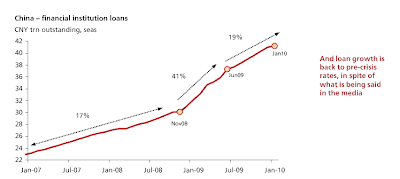
Well, I was doing some of routine jobs today, and I decided to post here some of charts I was looking at today. The first one is almost one month old, available via The Big Picture, courtesy of Societe Generale (should be able to read the full report till the end of March 2010). China is leading?

The next one is the Aruoba-Diebold-Scotti business conditions index for the United States, that "is designed to track real business conditions at high frequency. Its underlying economic indicators (weekly initial jobless claims; monthly payroll employment, industrial production, personal income less transfer payments, manufacturing and trade sales; and quarterly real GDP) blend high- and low-frequency information and stock and flow data." More up-to-date ADS info here. Courtesy of Philadelphia Fed.

Then, we had a newcomer for the US in the last weeks. James Hamilton has a nice post with links to additional info and sources at Econbrowser recently, read for additional info (INCLUDING COMMENTS) this post here.
 Then, I had criticized this one for wrong or right late last year, the ECRI's WLI ... Barron's had the chart ready, but bearish approach, while the ECRI itself is less bearish ... Click on chart to enlarge, courtesy of Barron's.
 Somehow difficult to buy stocks? I am not at the very moment. Well, we often get things wrong via media ...
Well, I was doing some of routine jobs today, and I decided to post here some of charts I was looking at today. The first one is almost one month old, available via The Big Picture, courtesy of Societe Generale (should be able to read the full report till the end of March 2010). China is leading?

The next one is the Aruoba-Diebold-Scotti business conditions index for the United States, that "is designed to track real business conditions at high frequency. Its underlying economic indicators (weekly initial jobless claims; monthly payroll employment, industrial production, personal income less transfer payments, manufacturing and trade sales; and quarterly real GDP) blend high- and low-frequency information and stock and flow data." More up-to-date ADS info here. Courtesy of Philadelphia Fed.

Then, we had a newcomer for the US in the last weeks. James Hamilton has a nice post with links to additional info and sources at Econbrowser recently, read for additional info (INCLUDING COMMENTS) this post here.
 Then, I had criticized this one for wrong or right late last year, the ECRI's WLI ... Barron's had the chart ready, but bearish approach, while the ECRI itself is less bearish ... Click on chart to enlarge, courtesy of Barron's.
 Somehow difficult to buy stocks? I am not at the very moment. Well, we often get things wrong via media ...
Friday, March 12, 2010
Morgan Stanley Sees An Unusual Recovery
From the today's "Downunder Daily", click on chart to enlarge, courtesy of Morgan Stanley.


As I am going to push on "publish post", I open "The Sham Recovery" ...
It Is Not Only Dr. Copper Sick...
Alan Heap, the commodities strategist at Citigroup Global Markets, writes today about copper price and inventory disconnect:
Click on chart to enlarge, courtesy of Citigroup Global Markets.
 The same virus can be detected in other commodities, here you can get much more insight about the oil markets ...
Prices and Inventories are out of kilter — Prices for all the base metals are way higher than traditional price:inventory relations would imply.
Causes center on speculative/investment demand — Firstly, there is a short term influence. Investors are prepared to buy now in the expectation that markets will tighten later in 2010.
Secondly a structural influence — Increased long positions (investor buying) and reduced shorts (producer selling and speculators) create an imbalance which requires higher prices to attract sufficient shorts to balance the market.
Click on chart to enlarge, courtesy of Citigroup Global Markets.
 The same virus can be detected in other commodities, here you can get much more insight about the oil markets ...
Thursday, March 11, 2010
Asia Has Got New Shoes
Singaporean DBS delivers its quarterly Asian story today. There are a lot of nice charts that tell the hope. Click on charts to enlarge, courtesy of DBS.
 This one is quite interesting, especially if you keep in mind the Chinese "cash for wash-machine" initiative.
 A bit curious about this, as Chinas fixed asset investment is supposed to be falling since mid-2009.
 At the same time local governments have been leveraging up heavily?
 By the way, try to get the Chinese story on the same line with the one drawn by CLSA Asia-Pacific Markets!
 This one is quite interesting, especially if you keep in mind the Chinese "cash for wash-machine" initiative.
 A bit curious about this, as Chinas fixed asset investment is supposed to be falling since mid-2009.
 At the same time local governments have been leveraging up heavily?
 By the way, try to get the Chinese story on the same line with the one drawn by CLSA Asia-Pacific Markets!
Wednesday, March 10, 2010
US Small Business Simply Does Not Get This Rise Of Lycans
The US government' s "Wards of the State" are on big mission today again. Of course, there is a hope in case of short squeeze! Did we have this rise of Lycans already before? US banks are ready for subprime credit again! Well, we have to close still today, but there is clear attempt to break out into new recovery highs. For an up-to-date chart of KBW Bank index click here. Click on chart to enlarge, courtesy of StockCharts.com.

However, the small business in the US simply does not get this recovery, according to NFIB Small Business Confidence Survey. Societe Generale notes this morning:
Well, but small business generates majority of what? Jobs? GDP? What else? Or not anymore? Click on chart to enlarge, courtesy of Societe Generale.
 Back to bull market anniversary. Tobias Levkovich, the US equity strategist at Citigroup Global Markets, wrote yesterday:

However, the small business in the US simply does not get this recovery, according to NFIB Small Business Confidence Survey. Societe Generale notes this morning:
Small business optimism lost 1.3 point in February, falling back to the December level of 88.0. The persistence of readings below 90 points is unprecedented in survey history, and shows that unlike other sectors of the economy, small businesses are still far from seeing light at the end of the tunnel.
Well, but small business generates majority of what? Jobs? GDP? What else? Or not anymore? Click on chart to enlarge, courtesy of Societe Generale.
 Back to bull market anniversary. Tobias Levkovich, the US equity strategist at Citigroup Global Markets, wrote yesterday:
We believe upside potential remains. Given that the yr/yr recovery in equity prices relative to 10-year bond returns has been the best since the 1940s (see Figure 1), many investors believe the opportunity has passed. Yet, one does need to look at the 1930s for a moment and recognize that after the plunge in 2008/09, the ability to recover can be quite substantive and more lasting than may commonly be believed. Thus, it may be misleading to think that the upside appreciation potential from here is limited.Admittedly, this is more of a trading scenario since the outlook into 2011 does remain clouded and it is plausible that further gains may face additional challenges by late 2010.Click on chart to enlarge, courtesy of Citigroup Global Markets.

Was this well said by James Montier?:
Paul Samuelson put it best when he opined “Investing should be dull, like watching paint dry or grass grow”.
Tuesday, March 09, 2010
Deutsche Targets 1250 For S&P500 On Futures Unwind By April Payrolls
The super-bull team led by Binky Chadha from the German house of Deutsche Bank has the "technical positioning" story of the 1250 target for S&P500:
The team of sweet strategists forgot to mention that "the dumb" speculators were net short with large positions at the market top in 2007, and well into 2008. Click on chart to enlarge, courtesy of Deutsche Bank, my annotation with red ellipse.
 And they continue with reasoning as follows:
Anatomy of the correction: Net short in futures at all-time high In terms of fundamentals, following the relatively uninterrupted rally of 70% from the March lows, there was a growing consensus for a correction (-10%). In the event, the sequence of three shocks in quick succession (China tightening; Greece sovereign risk; and Washington policy risk) trumped much-better-than-expected Q4 earnings, resulting in a peak-to-trough 9% sell-off. We argued that the selldown was a temporary correction and an economic recovery was far from being priced into US equities (US Equity Strategy, What’s Working? February 10, 2010). In terms of flows and positioning, the sell-down saw notable outflows from mutual funds (1.4% of AUM); mutual funds and hedge funds reduced exposure to the market by 8 and 20 percentage points, respectively; and most notably, the S&P 500 net futures short position increased by ~60k contracts, to an all-time high. The latter short was bigger than last March, which saw the S&P fall 15% over the month ...
The team of sweet strategists forgot to mention that "the dumb" speculators were net short with large positions at the market top in 2007, and well into 2008. Click on chart to enlarge, courtesy of Deutsche Bank, my annotation with red ellipse.
 And they continue with reasoning as follows:
The underweight positioning overhang remains Equity flows turned modestly positive over the last two weeks, but have further to recover in cumulative terms. Mutual fund positioning turned up from underweight to neutral. However, long-short equity hedge funds positioning remains more than 10 percentage points underweight relative to November-December levels and 15-20 pp below pre-financial crisis levels. Most importantly, the record net short S&P 500 futures position as of Tuesday last week had barely begun to be covered.
This, however, does not fit well with this puzzle of 3.6% cash by portfolio managers ... Did we send those bears already in retirement? But you know more about the risks now.
Look forward for this:
Our estimate of the implications of an unwinding of the net futures short position to average levels is S&P 500 upside to 1250. The key fundamental catalyst for the unwinding of positions remains, in our view, a recovery in the labor market. We expect March payrolls will be up a strong +350k (underlying recovery and a snowstorm snap-back) but the market will likely only get more confident with a second increase in payrolls in April.
Be careful! We are on a mission ...
Reading Auerback/Parenteau: Coming to a Country Near You: Let a dozen Latvias bloom?
Interesting reading at naked capitalism: Auerback/Parenteau: Coming to a Country Near You: Let a dozen Latvias bloom?
This provides some flavor of the script:
Just a wrong reminder that equity is wiped out before the debt is hit?
This provides some flavor of the script:
The US has so far managed to resist anything of this magnitude. But as the voices of fiscal retrenchment intensify, a future not unlike Latvia, Greece and Argentina could await. It has taken the people of Iceland to make the first stand against this growing neo-liberal madness.
...
It is now time for the rest of us to follow the Lilliputians of Iceland: to take the rentier juggernaut down before it completes the task. Time to pry the vampire squid off our faces so we can see the light of day again. Hopefully, Iceland represents the future, not Latvia.
Just a wrong reminder that equity is wiped out before the debt is hit?
Monday, March 08, 2010
Ready For Subprime Credit Recovery?
US markets are in excellent mood after non-farm payrolls test last Friday. The sub-prime nation even enjoys the household credit recovery. But was it a surprise? There is no wonder that Consumer Discretionary and Financials stocks are among the best performers recently.
These perma-bears? No, some are turning even bullish! Hmmm, there is no new normal ...
Well, some pullback is in cards. Technical setup is bullish, and the next move should be strong and large ... but still not sure - what direction?
These perma-bears? No, some are turning even bullish! Hmmm, there is no new normal ...
Well, some pullback is in cards. Technical setup is bullish, and the next move should be strong and large ... but still not sure - what direction?
Friday, March 05, 2010
Klarman's False Lessons
Seth Klarman (look no further than left upper corner of this web-page) in his annual letter described 20 lessons from the financial crisis which, he says, “were either never learned or else were immediately forgotten by most market participants.”
H/T My Investing Notebook, original source at http://www.valueinvestorinsight.com/
I list here the amazing "False Lessons":
I am lean and with tons of cash on hands, and waiting for nuclear bomb to hit the market :) ... making myself for fresh approach next week.
H/T My Investing Notebook, original source at http://www.valueinvestorinsight.com/
I list here the amazing "False Lessons":
It would be really enough if we might learn at least the false lessons, for more lessons look here ...There are no long-term lessons – ever.
Bad things happen, but really bad things do not. Do buy the dips, especially the lowest quality securities when they come under pressure, because declines will quickly be reversed.
There is no amount of bad news that the markets cannot see past.
If you’ve just stared into the abyss, quickly forget it: the lessons of history can only hold you back.
Excess capacity in people, machines, or property will be quickly absorbed.
Markets need not be in sync with one another. Simultaneously, the bond market can be priced for sustained tough times, the equity market for a strong recovery, and gold for high inflation. Such an apparent disconnect is indefinitely sustainable.
In a crisis, stocks of financial companies are great investments, because the tide is bound to turn. Massive losses on bad loans and soured investments are irrelevant to value; improving trends and future prospects are what matter, regardless of whether profits will have to be used to cover loan losses and equity shortfalls for years to come.
The government can reasonably rely on debt ratings when it forms programs to lend money to buyers of otherwise unattractive debt instruments.
The government can indefinitely control both short-term and long-term interest rates.
The government can always rescue the markets or interfere with contract law whenever it deems convenient with little or no apparent cost. (Investors believe this now and, worse still, the government believes it as well. We are probably doomed to a lasting legacy of government tampering with financial markets and the economy, which is likely to create the mother of all moral hazards. The government is blissfully unaware of the wisdom of Friedrich Hayek: “The curious task of economics is to demonstrate to men how little they really know about what they imagine they can design.”)
I am lean and with tons of cash on hands, and waiting for nuclear bomb to hit the market :) ... making myself for fresh approach next week.
Subscribe to:
Posts (Atom)