Showing posts with label Commodities. Show all posts
Showing posts with label Commodities. Show all posts
Tuesday, July 05, 2011
Moody's Does Not Like Portugal
As the European government debt crisis just seemed to turn the corner, Moody's junked the Portugal today...


Monday, July 04, 2011
Credit Agricole: Sisyphus Cannot Simply Kick The Can Down The Road
Posting will be very light, or even absent in July. For the longer reading the latest macro prospects by Credit Agricole are at your disposal here.
Thursday, June 23, 2011
80 JPY In Focus Too
Another "inflection point" on my screens is the mark of 80 Japanese yens (JPY) per 1 US dollar. This is rather important for Japan in watching the Chinese slowdown.
"... Preliminary China June PMI Falls to 11-Month Low", as per WSJ.com today:
The preliminary HSBC PMI declined from a final reading of 51.6 in May, while the manufacturing output sub-index fell to an 11-month low of 50 from the previous month's 50.9, HSBC Holdings PLC said Thursday.
Of course, the soft landing in China is consensus view, but the tight liquidity situation may bring some "fat tails". However, the 80 JPY mark will show where the market goes ...
Click on chart to enlarge, courtesy of Reuters.
![]()
"... Preliminary China June PMI Falls to 11-Month Low", as per WSJ.com today:
The preliminary HSBC PMI declined from a final reading of 51.6 in May, while the manufacturing output sub-index fell to an 11-month low of 50 from the previous month's 50.9, HSBC Holdings PLC said Thursday.
Of course, the soft landing in China is consensus view, but the tight liquidity situation may bring some "fat tails". However, the 80 JPY mark will show where the market goes ...
Click on chart to enlarge, courtesy of Reuters.

Tuesday, June 21, 2011
Nomura: How Much Of A US Slowdown Is In The Price?
Interesting observations by strategists at Nomura today:
While June ISM risks are skewed to the downside, growth-related assets seem to be underestimating the possibility of a disappointing outcome. Figure 1 compares the ISM index with the year-on-year changes in our common measure of US market-implied growth, which we define as the first component of a PCA on a group of US growth-related assets. It is apparent that after months of relative pessimism the market is now trying to look through the recent data and view it as a transitory slowdown. As such, growth assets appear vulnerable to further disappointing data in June. Currently, on this simplistic measure the market implies an ISM of roughly 57.0 vs our economists forecast of 51.8 and the Philly Fed's dismal ISM-equivalent reading of 45.5.
While buying Treasuries and selling stocks would be the natural trade to position for a deeper-than-expected ISM dip, optimising this trade could be key given current valuations. Figure 2 looks at the relative mispricing of each asset with respect to the common US growth component. Clearly, while Treasuries would benefit from a disappointing growth outcome, yields already appear too low compared with the rest of the assets in our universe and arguably offer only a limited reward. Conversely, S&P Consumer services, oil and copper still appear too optimistic with respect to growth, despite their recent retrenchment, and thus offer an interesting trade for investors positioning for a longer and deeper "soft patch" than currently expected.
Click on charts to enlarge, courtesy of Nomura.
![]()
Well, markets seem to be focused on "technically oversold" conditions and Greek "victory" today...
While June ISM risks are skewed to the downside, growth-related assets seem to be underestimating the possibility of a disappointing outcome. Figure 1 compares the ISM index with the year-on-year changes in our common measure of US market-implied growth, which we define as the first component of a PCA on a group of US growth-related assets. It is apparent that after months of relative pessimism the market is now trying to look through the recent data and view it as a transitory slowdown. As such, growth assets appear vulnerable to further disappointing data in June. Currently, on this simplistic measure the market implies an ISM of roughly 57.0 vs our economists forecast of 51.8 and the Philly Fed's dismal ISM-equivalent reading of 45.5.
While buying Treasuries and selling stocks would be the natural trade to position for a deeper-than-expected ISM dip, optimising this trade could be key given current valuations. Figure 2 looks at the relative mispricing of each asset with respect to the common US growth component. Clearly, while Treasuries would benefit from a disappointing growth outcome, yields already appear too low compared with the rest of the assets in our universe and arguably offer only a limited reward. Conversely, S&P Consumer services, oil and copper still appear too optimistic with respect to growth, despite their recent retrenchment, and thus offer an interesting trade for investors positioning for a longer and deeper "soft patch" than currently expected.
Click on charts to enlarge, courtesy of Nomura.

Well, markets seem to be focused on "technically oversold" conditions and Greek "victory" today...
Friday, June 17, 2011
Chinese "Quantitative Easing" In One Chart
From the economists at Morgan Stanley, the Chinese growth miracle explained in one chart. Though, not the full story.
Click on chart to enlarge, courtesy of Morgan Stanley.
![]()
Add the fiscal "orgy" to this...
Click on chart to enlarge, courtesy of Morgan Stanley.

Add the fiscal "orgy" to this...
Thursday, June 16, 2011
Jump In Correlations In European Credit Markets
The message from credit strategists at BNP Paribas today:
A confluence of events has increased volatility which could turn systemic in nature. With correlations bunching up once again and trending towards 1.0, the message from the markets is loud and clear that systemic risk is rising and liquidity is poor, which is being reflected in higher volatility and risk premia.
Click on chart to enlarge, courtesy of BNP Paribas.

If this is not enough, one should consider - what has made US markets "so weak" recently?
Click on chart to enlarge, courtesy of BNP Paribas.

Well, ECRI tells us not to blame Japan for slowdown ...
A confluence of events has increased volatility which could turn systemic in nature. With correlations bunching up once again and trending towards 1.0, the message from the markets is loud and clear that systemic risk is rising and liquidity is poor, which is being reflected in higher volatility and risk premia.
Click on chart to enlarge, courtesy of BNP Paribas.

If this is not enough, one should consider - what has made US markets "so weak" recently?
Click on chart to enlarge, courtesy of BNP Paribas.

Well, ECRI tells us not to blame Japan for slowdown ...
Tuesday, June 14, 2011
Just In Case You Thought QE2 Is Already Priced In
The strategists at Societe Generale think that QE2 is NOT priced in yet, and paint a picture of what lies ahead.
Click on charts to enlarge, courtesy of Societe Generale.
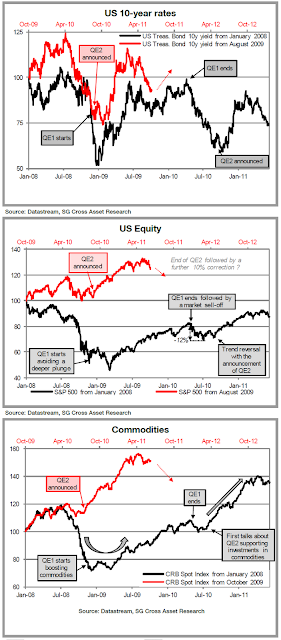
Indeed, it may be far from "worst is over" until capitulation sets in ...
Click on charts to enlarge, courtesy of Societe Generale.

Indeed, it may be far from "worst is over" until capitulation sets in ...
No Capitulation For Merrill's Fund Managers
They were about Fading Or Risking last month, this month key messages from BofA Merrill Lynch Global Fund Manager Survey are as follows:
No capitulation... no QE3
In the June FMS investors raised cash, reduced risk asset exposure and rotated to defensive sectors. But investor panic is not yet visible. The recent drop in global growth expectations stabilized and despite sharply lower inflation readings, two-thirds of investors predict no QE3.
Growth expectation stabilise
Growth and profit expectations stabilised after recent sharp falls. Inflation expectations fell to 38% from 69% two months ago. But the macro backdrop is not seen as weak enough to warrant more stimulus: three out of four panellists think a recession unlikely and only 13% expect a new round of QE in H2.
Risk is off
The percentage of investors OW cash rose to 21%, the highest since July-09. Actual cash balances rose from 3.9% to 4.2% but this did not trigger a buy signal from our trading rule. Hedge funds cut gearing levels sharply to 1.27x from 1.53x while 43% of investors believe EU sovereign debt funding is the biggest "tail risk". Overall our risk & liquidity index fell to 38, below its long term average of 40.
Gold overvaluation highest since 2009
Equity allocations fell, benefiting bonds and cash, but positioning overall stands in the middle of historic ranges. Note that the gold price is seen as more overvalued than at anytime since Dec-09 while commodity allocations again fell.
Japan remains most unloved market
Despite China growth expectations dropping to the lowest reading since Jan-09, EM remains the most preferred region for equities, pipping the US. Regional allocations show a big drop in exposure to Eurozone and UK equities but Japan remains the most unloved equity region.
Bank underweight most negative since March 2009
Contrarians note that the weighting in global banks fell to its lowest since March 2009. Consumer discretionary saw the largest monthly drop in exposure with the only positive sector moves coming from defensives. Tech remains the most popular sector followed by pharma and energy.
Contrarian trades...
Despite no contrarian "buy" signal for risk being triggered, the contrarian trades within the June FMS are: long banks, short gold; long Japanese banks, short US tech; long Eurozone, short EM; long US dollar, short Japanese yen.
Click on chart to enlarge, courtesy of BofA Merrill Lynch.

I have no intention to be contrarian this month ...
No capitulation... no QE3
In the June FMS investors raised cash, reduced risk asset exposure and rotated to defensive sectors. But investor panic is not yet visible. The recent drop in global growth expectations stabilized and despite sharply lower inflation readings, two-thirds of investors predict no QE3.
Growth expectation stabilise
Growth and profit expectations stabilised after recent sharp falls. Inflation expectations fell to 38% from 69% two months ago. But the macro backdrop is not seen as weak enough to warrant more stimulus: three out of four panellists think a recession unlikely and only 13% expect a new round of QE in H2.
Risk is off
The percentage of investors OW cash rose to 21%, the highest since July-09. Actual cash balances rose from 3.9% to 4.2% but this did not trigger a buy signal from our trading rule. Hedge funds cut gearing levels sharply to 1.27x from 1.53x while 43% of investors believe EU sovereign debt funding is the biggest "tail risk". Overall our risk & liquidity index fell to 38, below its long term average of 40.
Gold overvaluation highest since 2009
Equity allocations fell, benefiting bonds and cash, but positioning overall stands in the middle of historic ranges. Note that the gold price is seen as more overvalued than at anytime since Dec-09 while commodity allocations again fell.
Japan remains most unloved market
Despite China growth expectations dropping to the lowest reading since Jan-09, EM remains the most preferred region for equities, pipping the US. Regional allocations show a big drop in exposure to Eurozone and UK equities but Japan remains the most unloved equity region.
Bank underweight most negative since March 2009
Contrarians note that the weighting in global banks fell to its lowest since March 2009. Consumer discretionary saw the largest monthly drop in exposure with the only positive sector moves coming from defensives. Tech remains the most popular sector followed by pharma and energy.
Contrarian trades...
Despite no contrarian "buy" signal for risk being triggered, the contrarian trades within the June FMS are: long banks, short gold; long Japanese banks, short US tech; long Eurozone, short EM; long US dollar, short Japanese yen.
Click on chart to enlarge, courtesy of BofA Merrill Lynch.

I have no intention to be contrarian this month ...
Monday, June 13, 2011
Barclays On US Deflation Risks
While the equity investors like the industrialists of Weimar Republic are awaiting for the first hints of QE3 by Fed, I was a bit surprised that the risk of deflation appears like a distant probability. Here the latest take by economists at Barclays Capital:
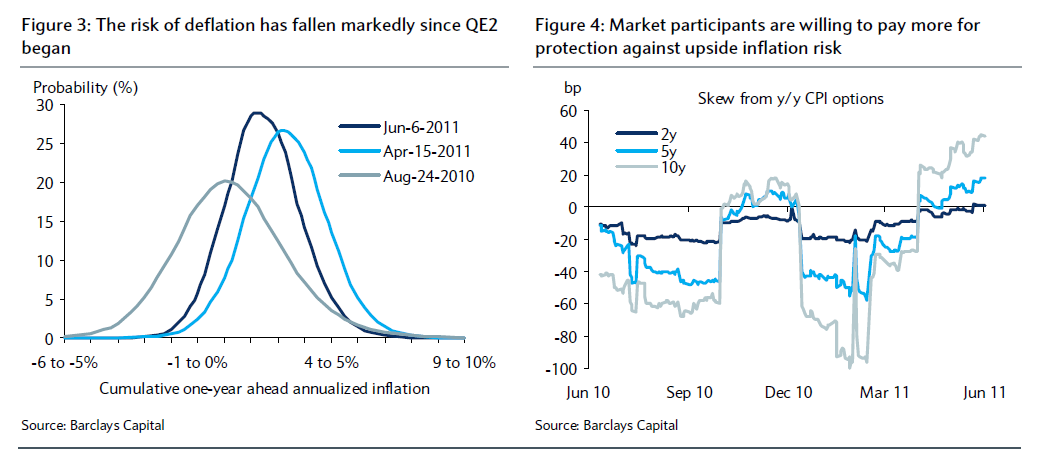
The increase in inflation and inflation expectations has also coincided with a reduction in deflation risk. Figure 3 shows the probability of cumulative inflation over a one-year horizon using information from both TIPS and CPI options data. The figure shows that the probability of deflation over the one-year ahead horizon in August of last year was 36%. When 5y5y breakeven inflation reached its recent high in April of this year, the probability had fallen to about 3%. Currently, it stands at about 7%. In addition, Figure 4 shows that the market remains more willing to pay for protection against upside inflation risks than protection against excessive deflation risk. The figure plots the difference in premiums paid on +200bp out-of-the-money inflation caps and -200bp out-of-the-money inflation floors for different horizons. Because an inflation cap pays off when cumulative inflation exceeds the threshold specified in the contract, a positive reading is an indication that the caps are more expensive than the floors; in other words, the market sees the distribution of expected inflation as skewed in the direction of upside inflation risk. The trends from CPI options markets suggest that skew has been moving in the direction of willingness to pay for protection against upside inflation risk, whereas for much of last year, participants were willing to pay more for protection against deflation.
Altogether, we see the trends in inflation markets as consistent with Chairman Bernanke’s comments in his April press conference that the balance of risks between seeking additional progress on its dual mandate relative to further balance sheet expansion was “less attractive” than it was a year earlier. We therefore see the Fed as inclined to remain patient. If incoming data confirm the Fed’s view that the economy is turning up in the second half of the year, the FOMC will likely continue on its path towards normalizing the policy stance. However, if the recovery fails to regain momentum, the balance of risks may shift back in favor of further Fed action.
Click on charts to enlarge, courtesy of Barclays Capital.

Well, just in case ... "if the recovery fails to regain momentum". Why it should?
The increase in inflation and inflation expectations has also coincided with a reduction in deflation risk. Figure 3 shows the probability of cumulative inflation over a one-year horizon using information from both TIPS and CPI options data. The figure shows that the probability of deflation over the one-year ahead horizon in August of last year was 36%. When 5y5y breakeven inflation reached its recent high in April of this year, the probability had fallen to about 3%. Currently, it stands at about 7%. In addition, Figure 4 shows that the market remains more willing to pay for protection against upside inflation risks than protection against excessive deflation risk. The figure plots the difference in premiums paid on +200bp out-of-the-money inflation caps and -200bp out-of-the-money inflation floors for different horizons. Because an inflation cap pays off when cumulative inflation exceeds the threshold specified in the contract, a positive reading is an indication that the caps are more expensive than the floors; in other words, the market sees the distribution of expected inflation as skewed in the direction of upside inflation risk. The trends from CPI options markets suggest that skew has been moving in the direction of willingness to pay for protection against upside inflation risk, whereas for much of last year, participants were willing to pay more for protection against deflation.
Altogether, we see the trends in inflation markets as consistent with Chairman Bernanke’s comments in his April press conference that the balance of risks between seeking additional progress on its dual mandate relative to further balance sheet expansion was “less attractive” than it was a year earlier. We therefore see the Fed as inclined to remain patient. If incoming data confirm the Fed’s view that the economy is turning up in the second half of the year, the FOMC will likely continue on its path towards normalizing the policy stance. However, if the recovery fails to regain momentum, the balance of risks may shift back in favor of further Fed action.
Click on charts to enlarge, courtesy of Barclays Capital.
Well, just in case ... "if the recovery fails to regain momentum". Why it should?
Friday, June 03, 2011
More Than 1000 Words Can Tell
The Blogosphere went on to look at US real wage growth today, e.g., comparing it to Great Depression, but has been my focus for a while already. Well, a nice picture from the team of Chris Wood at CLSA Asia-Pacific Markets yesterday.
Click on chart to enlarge, courtesy of CLSA Asia-Pacific Markets.

We need more stimulus, to drive trend consumption that was driven by debt bubble ...
Click on chart to enlarge, courtesy of CLSA Asia-Pacific Markets.

We need more stimulus, to drive trend consumption that was driven by debt bubble ...
Wednesday, May 25, 2011
Profit Margins Again
It just happens, as a follow-up on the post from yesterday, also the economists at BCA Research made their conclusions on the corporate profit margins yesterday. So, here some excerpts to consider:
Ultimately, the health of the corporate sector depends on the financial health of its customers. Thus, the divergence between rising profits and weak growth in real consumer incomes will have to change. Historically, the growth in real profits has been correlated closely with that of real consumer spending, and the wide gap in the current cycle represents a major aberration.
I have discussed the real consumer spending and especially the incomes that should drive that spending here earlier. So, here are the mains points about margins, according to BCA Research:
To conclude, the corporate sector has been enjoying a very favorable set of circumstances that will not persist. This does not mean that profit margins are about to plunge. Companies will remain intensely focused on cost control and boosting efficiency, and the weak dollar will continue to provide support to overseas earnings. However, it is hard to see margins moving higher from current levels in the coming year.
Margins and thus profits will face a severe challenge during the next recession. The ability to repeat this cycle’s aggressive cost cutting will be minimal, and pricing power will be under pressure. If we are going to have a mean reversion of margins, then that is when it will occur. A severe margin squeeze does not seem likely while the economy is still expanding.
All in all, not bad? Just imagine how much money has been thrown at non-existing problems. Save that challenge for next recession, while at least couple of bears were growling also today ...
Ultimately, the health of the corporate sector depends on the financial health of its customers. Thus, the divergence between rising profits and weak growth in real consumer incomes will have to change. Historically, the growth in real profits has been correlated closely with that of real consumer spending, and the wide gap in the current cycle represents a major aberration.
I have discussed the real consumer spending and especially the incomes that should drive that spending here earlier. So, here are the mains points about margins, according to BCA Research:
To conclude, the corporate sector has been enjoying a very favorable set of circumstances that will not persist. This does not mean that profit margins are about to plunge. Companies will remain intensely focused on cost control and boosting efficiency, and the weak dollar will continue to provide support to overseas earnings. However, it is hard to see margins moving higher from current levels in the coming year.
Margins and thus profits will face a severe challenge during the next recession. The ability to repeat this cycle’s aggressive cost cutting will be minimal, and pricing power will be under pressure. If we are going to have a mean reversion of margins, then that is when it will occur. A severe margin squeeze does not seem likely while the economy is still expanding.
All in all, not bad? Just imagine how much money has been thrown at non-existing problems. Save that challenge for next recession, while at least couple of bears were growling also today ...
Thursday, May 19, 2011
Still Some Adjustments In Labor Legacy Costs To Expect
Charts below are self-explanatory, while housing is non-productive and legacy cost of domestic labor. I marked some countries that I believe deserve attention.
Click on charts to enlarge, courtesy of Goldman Sachs, my annotations in red and yellow.

More than couple of those "marked" countries are enjoying record high housing prices in nominal, real and relative terms now.
Click on charts to enlarge, courtesy of Goldman Sachs, my annotations in red and yellow.

More than couple of those "marked" countries are enjoying record high housing prices in nominal, real and relative terms now.
Tuesday, May 17, 2011
European Debt Sinners
While Europeans are not the only sinners, the majority of brains with money are focused on EU sovereign debt issues. Economists at Erste Bank delivered excellent reminders today - who is who in this game?
Click on charts to enlarge, courtesy of Erste Bank.


Click on charts to enlarge, courtesy of Erste Bank.


Merrill's Fund Managers Are Fading Or Risking
We saw Reluctant Equity Bulls last month, this month key messages from BofA Merrill Lynch Global Fund Manager Survey are as follows:
The potential summer surprises
The May FMS sees investors questioning global growth (in a re-run of summer 2010) but enjoying ample liquidity that keeps risk appetite high. A stand-off has ensued with little change in allocation across asset classes but some switching within asset classes, typified by defensive rotation within equities. The summer surprises are either growth to the upside or liquidity disappointing as QE2 ends.
Growth expectations are falling
Only a net 10% of investors expect stronger global economic growth in the next 12m, down from 58% in Feb. This is easing inflation concerns, albeit marginally, with a net 61% seeing higher inflation down from 75% in March.
Risk appetite resilient
Three-quarters of the panel expect no Fed rate rise before 2012 and so risk appetite remains firm. Hedge funds are risk-on with 1.53x gearing the highest since Nov-07. Cash balances rose to 3.9% up from 3.7%, but remain low. Our risk appetite indicator eased to 43 but is well above the average of 40.
EU debt the tail risk but watch China
Growth fears see EU debt issues again ranking as the main investment risk. A slightly lower EU growth outlook (49 vs. 52) is being offset by US resilience and a rebound in Japan sentiment (74 vs. 42). A bigger concern is the deeper decline in China optimism with a net 28% seeing weaker growth compared to 15% in March.
Asset allocation: very modest change
Asset allocation saw modest rotation into bonds (48% UW from 58%) funded by lower commodities (12% OW vs. 24%) and equities (41% OW vs. 50%). GEM regains its position of most preferred region (29% OW vs. 22%) replacing US (26% OW). Consensus is UW Europe (-1%) and Japan (-17%). USD sentiment (48% undervalued) is one of the highest readings since 2002.
Sector rotation: defensive rotation
Sharp falls in energy (to 19% OW from 40%) and materials (2% UW from 17% OW) accompanied a sharp defensive rotation into staples (8% OW from 6% UW), pharma and telecoms. Banks are once again the most unpopular sector (26% UW down from 15%) with technology by far the most popular (35% OW).
How to trade the risk scenarios
If the summer sees stronger-than-expected growth: long banks, short pharma; long commodities, short bonds. If the summer sees weaker liquidity: long bonds, short equities; long US$, short EM.
Click on chart to enlarge, courtesy of BofA Merrill Lynch.

While there is still room for "feel good" short-term rally, it is more likely to see weaker liquidity over summer ...
The potential summer surprises
The May FMS sees investors questioning global growth (in a re-run of summer 2010) but enjoying ample liquidity that keeps risk appetite high. A stand-off has ensued with little change in allocation across asset classes but some switching within asset classes, typified by defensive rotation within equities. The summer surprises are either growth to the upside or liquidity disappointing as QE2 ends.
Growth expectations are falling
Only a net 10% of investors expect stronger global economic growth in the next 12m, down from 58% in Feb. This is easing inflation concerns, albeit marginally, with a net 61% seeing higher inflation down from 75% in March.
Risk appetite resilient
Three-quarters of the panel expect no Fed rate rise before 2012 and so risk appetite remains firm. Hedge funds are risk-on with 1.53x gearing the highest since Nov-07. Cash balances rose to 3.9% up from 3.7%, but remain low. Our risk appetite indicator eased to 43 but is well above the average of 40.
EU debt the tail risk but watch China
Growth fears see EU debt issues again ranking as the main investment risk. A slightly lower EU growth outlook (49 vs. 52) is being offset by US resilience and a rebound in Japan sentiment (74 vs. 42). A bigger concern is the deeper decline in China optimism with a net 28% seeing weaker growth compared to 15% in March.
Asset allocation: very modest change
Asset allocation saw modest rotation into bonds (48% UW from 58%) funded by lower commodities (12% OW vs. 24%) and equities (41% OW vs. 50%). GEM regains its position of most preferred region (29% OW vs. 22%) replacing US (26% OW). Consensus is UW Europe (-1%) and Japan (-17%). USD sentiment (48% undervalued) is one of the highest readings since 2002.
Sector rotation: defensive rotation
Sharp falls in energy (to 19% OW from 40%) and materials (2% UW from 17% OW) accompanied a sharp defensive rotation into staples (8% OW from 6% UW), pharma and telecoms. Banks are once again the most unpopular sector (26% UW down from 15%) with technology by far the most popular (35% OW).
How to trade the risk scenarios
If the summer sees stronger-than-expected growth: long banks, short pharma; long commodities, short bonds. If the summer sees weaker liquidity: long bonds, short equities; long US$, short EM.
Click on chart to enlarge, courtesy of BofA Merrill Lynch.

While there is still room for "feel good" short-term rally, it is more likely to see weaker liquidity over summer ...
Monday, May 16, 2011
Importance Of "Difficult To Measure" China's Growth
After the Blogger's black-out on Friday, I am back with old issues. There was a post back last November featuring the economists at Societe Generale on China driving the global manufacturing cycle. Now last Friday, but this time at Nomura, macro strategists have been trying to gauge the importance of China's growth:
While difficult to measure, we would argue China's growth has been one of a few core drivers of financial trends since the start of its recovery in early 2009. Figures 1 & 2 look at the performance of equities and currencies since the start of 2002. Each chart divides the world between those markets fundamentally linked to China and those not. These universes are then weighted by the size of imports to China as a percent of GDP. While it is difficult to gauge from these charts how important China's growth has been in driving the extent of the market recovery, its importance in driving relative trends should be pretty clear. In equity markets, countries fundamentally linked to China have outperformed other markets by nearly two-thirds over the course of the recovery. During the previous seven years, the performance between the two groups was practically indistinguishable. We have seen a similar trend in currencies. Since the beginning of the recovery, real effective exchange rates of countries linked to China have outperformed those of other countries substantially – although, unlike the equity performance, the FX outperformance of China-linked countries has simply gone some way in closing a valuation gap.
Click on charts to enlarge, courtesy of Nomura.

Well, at the end of day it is difficult to measure ...
While difficult to measure, we would argue China's growth has been one of a few core drivers of financial trends since the start of its recovery in early 2009. Figures 1 & 2 look at the performance of equities and currencies since the start of 2002. Each chart divides the world between those markets fundamentally linked to China and those not. These universes are then weighted by the size of imports to China as a percent of GDP. While it is difficult to gauge from these charts how important China's growth has been in driving the extent of the market recovery, its importance in driving relative trends should be pretty clear. In equity markets, countries fundamentally linked to China have outperformed other markets by nearly two-thirds over the course of the recovery. During the previous seven years, the performance between the two groups was practically indistinguishable. We have seen a similar trend in currencies. Since the beginning of the recovery, real effective exchange rates of countries linked to China have outperformed those of other countries substantially – although, unlike the equity performance, the FX outperformance of China-linked countries has simply gone some way in closing a valuation gap.
Click on charts to enlarge, courtesy of Nomura.

Well, at the end of day it is difficult to measure ...
Thursday, May 12, 2011
So Much About Inflation
Tiny bit about inflation from monthly Macro Strategy Views by Standard Chartered today:
Yet there is no room for complacency, given that the current round of inflation is driven by massive monetary easing and by extraordinarily high commodity prices due to a mix of supply and demand factors. No single monetary, fiscal or exchange policy tool is sufficient to arrest the situation. Given initial signs that inflation is peaking, it is critical that EM policy makers are not seen as wavering in their determination to fight inflation, and are viewed as having sufficient flexibility to reduce the risk of a hard landing. While we expect most EM central banks to continue tightening in the coming months, some – such as Brazil and China – could be close to the end of their current hiking cycles.
Click on charts to enlarge, courtesy of Standard Chartered.

Do you hear the sweet and enchanting music of "...sufficient flexibility to reduce the risk of a hard landing" and "could be close to the end of their current hiking cycles"?
There are those seductresses, Greek bird-women ... well, but not because of inflation.
Yet there is no room for complacency, given that the current round of inflation is driven by massive monetary easing and by extraordinarily high commodity prices due to a mix of supply and demand factors. No single monetary, fiscal or exchange policy tool is sufficient to arrest the situation. Given initial signs that inflation is peaking, it is critical that EM policy makers are not seen as wavering in their determination to fight inflation, and are viewed as having sufficient flexibility to reduce the risk of a hard landing. While we expect most EM central banks to continue tightening in the coming months, some – such as Brazil and China – could be close to the end of their current hiking cycles.
Click on charts to enlarge, courtesy of Standard Chartered.

Do you hear the sweet and enchanting music of "...sufficient flexibility to reduce the risk of a hard landing" and "could be close to the end of their current hiking cycles"?
There are those seductresses, Greek bird-women ... well, but not because of inflation.
Wednesday, May 11, 2011
Grantham Gets Serious, While We Look At Bubbles In Terms Of Bubbles?
The legendary Jeremy Grantham moves on today and says it is Time To Be Serious ...
However, as I have been serious for a while, I decided to look at industrial metals in terms of gold, that was brought to me by good folks Citigroup Global markets today.
Click on charts to enlarge, courtesy of Citigroup Global Markets.


 Bubbles in terms of bubbles? Or, all we saw so far was just an adjustment in USD value? Well, we are indeed constrained by resources and capital in the real world, that are not reserves of fractional reserve banking.
However, as I have been serious for a while, I decided to look at industrial metals in terms of gold, that was brought to me by good folks Citigroup Global markets today.
Click on charts to enlarge, courtesy of Citigroup Global Markets.


Monday, May 09, 2011
Real Interest Rates And Credit Growth In Asia
The last days are traded in the sign of Greek-out, but for the sake of change we travel to Asia today.
This is a nice depiction of real growth drivers in Asia too. You simply arrange the God's Work with negative real rates, and credits simply fly, as economists at Deutsche Bank are writing:
Declining, and often negative, real interest rates against a backdrop of strong growth provide strong support for credit growth, which is rising in most Asian economies.
Click on chart to enlarge, courtesy of Deutsche Bank.

While I am not so sure that "strong growth provide strong support for credit growth", I would rather think the other way round. However, this seems to be more important now:
China is a key exception. Despite negative real interest rates, credit growth has slowed for most of the last 18 months after the surge in lending in support of the government’s stimulus program in early 2009. Interest rates do not play an important role in allocating or managing credit growth in China.
And once again, if you doubt the first paragraph, can you trust the second quote?
This is a nice depiction of real growth drivers in Asia too. You simply arrange the God's Work with negative real rates, and credits simply fly, as economists at Deutsche Bank are writing:
Declining, and often negative, real interest rates against a backdrop of strong growth provide strong support for credit growth, which is rising in most Asian economies.
Click on chart to enlarge, courtesy of Deutsche Bank.

While I am not so sure that "strong growth provide strong support for credit growth", I would rather think the other way round. However, this seems to be more important now:
China is a key exception. Despite negative real interest rates, credit growth has slowed for most of the last 18 months after the surge in lending in support of the government’s stimulus program in early 2009. Interest rates do not play an important role in allocating or managing credit growth in China.
And once again, if you doubt the first paragraph, can you trust the second quote?
Friday, May 06, 2011
Thursday, May 05, 2011
Beauty Of 5 Standard Deviations In This Real World
Felix Salmon has the de-coding story today:
In a normally-distributed world, 5-standard-deviation moves never happen. In this world, however, such moves can happen even when there’s no news at all. (Reuters, for what it’s worth, blames “concerns about economic growth and monetary tightening”, which is code for “we have no idea why this is happening, or whether there even is a reason”.)
Click on chart of "first month Brent Crude Oil futures" to enlarge, courtesy of Reuters.

In a normally-distributed world, 5-standard-deviation moves never happen. In this world, however, such moves can happen even when there’s no news at all. (Reuters, for what it’s worth, blames “concerns about economic growth and monetary tightening”, which is code for “we have no idea why this is happening, or whether there even is a reason”.)
Click on chart of "first month Brent Crude Oil futures" to enlarge, courtesy of Reuters.

Subscribe to:
Posts (Atom)