Swedbank goes kinda against the Anglo-Saxon wisdom as you can read these pieces posted earlier:
Reading Auerback/Parenteau: Coming to a Country Near You: Let a dozen Latvias bloom?
Edwardian Clash Over The Future Of Latvia
Reading On Latvia's Recession And Cost Of Adjustment With An "Internal Devaluation"
Deutsche Prescribes The Focus On Fiscal Performance For Baltics
Nordea's Litmus Test Of A Solid Foundation For Latvia's Long Term Growth
BNP Paribas EcoWeek Focus: Turmoil In The Baltic Countries
Somewhat wishful thinking (IMHO), but with focus on how to get on from here, worth reading thoughts on depression economics - Swedbank Analysis: Competitiveness adjustment in Latvia – no pain, no gain?
Friday, March 26, 2010


Disneyland Provides The Cure For Brain Damage?
The stock price of Walt Disney (DIS) has staged a nice V-shaped recovery, and erased the brain damage by Lehman's Psychopaths made in 2008. Disney runs, of course, a global business ...
Click on chart to enlarge, courtesy of Reuters.

It is interesting to see how the US consumer is getting around, as there is so much hope right now in the markets.
Click on chart, courtesy of CLSA Asia-Pacific Markets.
 Despite all the hope, Christopher Wood, the strategist at CLSA Asia-Pacific Markets, wrote yesterday:
Click on chart to enlarge, courtesy of Reuters.

It is interesting to see how the US consumer is getting around, as there is so much hope right now in the markets.
Click on chart, courtesy of CLSA Asia-Pacific Markets.
 Despite all the hope, Christopher Wood, the strategist at CLSA Asia-Pacific Markets, wrote yesterday:
The data suggests that the annualised 2.2% pick up in real consumer spending in the past two quarters has been driven by tax cuts and transfer payment benefits. Personal current transfer receipts rose by 14.3% YoY in 4Q09 while personal current taxes declined by 25.8% YoY. This consumption pick up is not ultimately sustainable unless underlying income growth or wage growth revives, of which there is as yet scant sign. Thus, while real disposable personal income has risen by 1.5% over the past two years as a result of tax cuts and transfer payment benefits, real wages and salaries have declined by 6% over the same period.
Very Keynesian? There are some grounds for optimism on capital expenditures in corporate sector... and some (all buyers of equities today?) believe this will revive the consumer spending thereafter, as corporate sector starts hiring again.
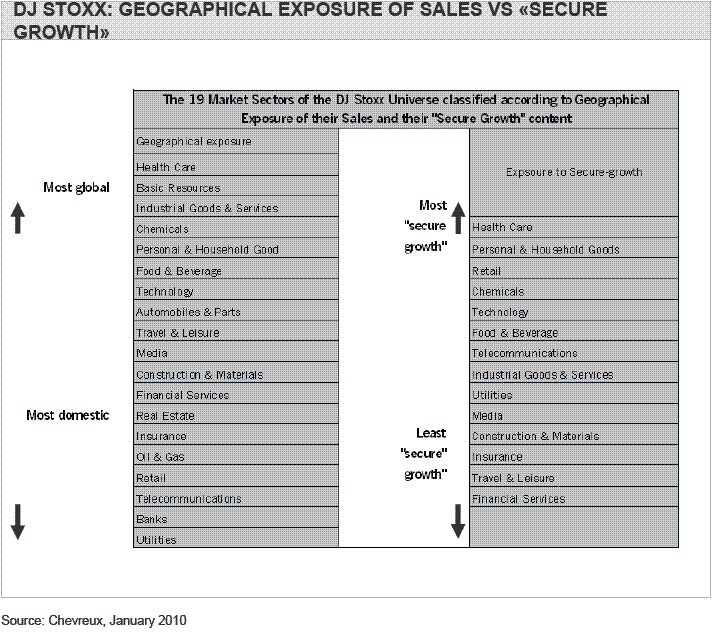
Some Ideas On European Geographical Exposure And "Secure Growth"
Depending on belief in either Greek Victory or Eurozone's Structural One, or even both, this may be a useful tool that comes via Pictet, sourced from Chevreux. Click on picture to enlarge.

Thursday, March 25, 2010
Closing Expectation Gaps And Getting Real With Options ...
I am back from Spring break ...
There are much more of a thing to do and share, but this appears to me the issue of the day. While watching the Michael Mauboussin, the Chief Investment Strategist at Legg Mason Capital Management and the author of “Think Twice: Harnessing the Power of Counterintuition,” speaking with James Surowiecki of The New Yorker ...
... I should admit that I enjoy reading the strategy pieces by Michael, click for them here. However, there are two issues that I am keeping in my mind. First, the minor issue, as his colleague Bill Miller, was nominated with THE 2008 ASSHAT OF THE YEAR AWARD by brutish "The Fly".
BUT, the BIG issue, as I recall a fascinating piece by Michael? Written back on 23rd June 1999 ...
Click on picture to enlarge, courtesy of Credit Suisse First Boston. I would like to share the whole wisdom, but no permission ...
 ... whereby we all got real by "Using Real Options in Security Analysis", as the historic context was challenging that time:
There are much more of a thing to do and share, but this appears to me the issue of the day. While watching the Michael Mauboussin, the Chief Investment Strategist at Legg Mason Capital Management and the author of “Think Twice: Harnessing the Power of Counterintuition,” speaking with James Surowiecki of The New Yorker ...
... I should admit that I enjoy reading the strategy pieces by Michael, click for them here. However, there are two issues that I am keeping in my mind. First, the minor issue, as his colleague Bill Miller, was nominated with THE 2008 ASSHAT OF THE YEAR AWARD by brutish "The Fly".
BUT, the BIG issue, as I recall a fascinating piece by Michael? Written back on 23rd June 1999 ...
Click on picture to enlarge, courtesy of Credit Suisse First Boston. I would like to share the whole wisdom, but no permission ...
 ... whereby we all got real by "Using Real Options in Security Analysis", as the historic context was challenging that time:
... a growing gap between how the market is pricing some businesses— especially those fraught with uncertainty—and the values generated by traditional valuation models such as discounted cash flow (DCF). Managers and investors instinctively understand that selected market valuations reflect a combination of known businesses plus a value for opportunities that are to come. Real options— a relatively new analytical tool—bridge this gap between hard numbers and intuition.Still thinking about the issue of brain damage ... and gigantic error of pessimism.
Tuesday, March 16, 2010
Breaking The Fed And Spring
While markets are busy parsing the FOMC, and is on (at least it attempts) to celebrate the end of QE, I declare the spring break for a week.
S&P Declares Greek Victory
The following is an excerpt form the press release from Standard & Poor's:
 The debt horror is over! Greek victory?
This is how German DAX equity index (intra-day chart below) reacts to Greek "victory" of not being "junked" due to poor fiscal standards, the S&P500 in the US has no less joy! Click on chart to enlarge, courtesy of Reuters.-- We view the Greek government's total package of deficit reduction measures as appropriate to achieve its 2010 fiscal target, given the deterioration in Greece's growth prospects.
-- We are affirming our 'BBB+/A-2' sovereign credit ratings on Greece and removing them from CreditWatch negative.
-- The negative outlook reflects our view of the government's ability to sustain reform momentum in the medium term.
 The debt horror is over! Greek victory?
Doing Homework By Candlelight
Candlelight? Sounds romantic? Wait a second, this is going to be a daily routine?
Albert Edwards, the prominent strategist at Societe Generale, writes today:
"2007-lite" balanced world around ...
Equities are good investments, if one believes that - without structural changes - governments around the world, by not "touching the corporate sector profits", will be able to compensate indefinitely the decline in aggregate demand that results from productivity growth and unemployment ...
Albert Edwards, the prominent strategist at Societe Generale, writes today:
Ultimately, as my colleague Dylan Grice writes, I think we head back to double-digit inflation rates as governments opt to default. I certainly again expect to see CPI inflation above 25% in the UK and indeed in most developed nations in my lifetime – I have happy memories of the three-day week and doing my homework by candlelight. In the near term, however, the deflationary quicksand will suck us ever lower until we suffocate. A key driver for underlying inflation remains unit labour costs. While unit labour costs decline at an unprecedented rate, they are sucking us inevitably into a Fisherian, debt-deflation spiral. Only then will we see how far policymakers are willing to go to debauch the currency. Last year saw them cross the Rubicon. Monetisation is now the policy lever of first resort.Click on chart to enlarge, courtesy of Societe Generale.
 Sub-prime crisis evolved as people did not have enough income to serve large debts. Large debts are here because of high asset prices. So, welcome asset reflation? I am glad to think especially about the food and energy inflation of 2008 proportions ...
"2007-lite" balanced world around ...
Equities are good investments, if one believes that - without structural changes - governments around the world, by not "touching the corporate sector profits", will be able to compensate indefinitely the decline in aggregate demand that results from productivity growth and unemployment ...
Reading "China's Growth Momentum Has Peaked"
Li & Fung Research Centre published quite a detailed "PMI Quarterly on China Manufacturing" yesterday. Worth reading the piece...
I noted the peak back in December. The button has been passed to US now...
I noted the peak back in December. The button has been passed to US now...
Monday, March 15, 2010
We Are So Early In Recovery?
Obsessed with recovery or a double dip? We are so early in recovery... Except for 1998.
Click on chart to enlarge, courtesy of Citigroup Global Markets.
 Fears of Chinese bubble reverberates ...
Click on chart to enlarge, courtesy of Citigroup Global Markets.
 Fears of Chinese bubble reverberates ...
Deutsche Paints Three Possible Broad Scenarios Today
Jim Reid, the strategist at Deutsche Bank, starts off the day be reminding:
Well, but Societe Generale sees their defined "Inflation Scenario" as the central one for the next 3-5 years, and prepares with appropriate asset allocation. Interestingly that this "Inflation Scenario" prefers only "some Equities". Click on slide to enlarge, courtesy of Societe Generale.
 Market seems enjoying the combination of "2007-lite" and "asymmetric" inflation scenario?
'2007-lite' is our term for policy makers trying to recreate conditions as close as they possibly can to pre-crisis levels via aggressive policy intervention. Given this, there are three possible broad scenarios going forward. 1) Its possible that policymakers around the Globe have pulled off a masterstroke and have propelled the Global economy back to sustainable growth and that the 'Great Recession' will be seen as severe but not one that had any major structural long-term impact on the economy; 2) The strong rebound in the Global economy will eventually be checked by the burden of higher debt and growth will settle at a notably lower trend rate than pre-crisis levels, especially in the Developed world. This is the 'new normal' type outcome; 3) The bill from the unparalleled intervention that saved the Global economy eventually leads to huge Sovereign financing problems possibly leading to a combination of higher yields, higher inflation or possibly restructuring/defaulting Sovereign debt.
Clearly these are very broad paths but knowing which one will prevail and when, is going to be the key medium-long term question that needs answering. Its entirely possible that we'll go through all three paths chronologically. If so timing is key. For now the market is happy that we are in scenario 1 and on days when the Sovereign headlines fade there is absolutely no doubt that this looks quite like a normal economic recovery in many places, and one which equity and credit markets can prosper in. However scenario 2 would be a much more difficult environment for them and scenario 3 would be a very negative backdrop.
Well, but Societe Generale sees their defined "Inflation Scenario" as the central one for the next 3-5 years, and prepares with appropriate asset allocation. Interestingly that this "Inflation Scenario" prefers only "some Equities". Click on slide to enlarge, courtesy of Societe Generale.
 Market seems enjoying the combination of "2007-lite" and "asymmetric" inflation scenario?
Subscribe to:
Posts (Atom)