People's time-preferences also determine the extent to which people will save and invest, as compared to how much they will consume. If people's time-preferences should fall, i.e., if their degree of preference for present over future falls, then people will tend to consume less now and save and invest more; at the same time, and for the same reason, the rate of interest, the rate of time-discount, will also fall. Economic growth comes about largely as the result of falling rates of time-preference, which lead to an increase in the proportion of saving and investment to consumption, and also to a falling rate of interest.Well, in this light the argument of Keynesian output gap is an intellectual trap? Even worse, if one believes that recovery will be driven by corporate investment ... only after depletion, or trouble follows soon again.
But what happens when the rate of interest falls, not because of lower time-preferences and higher savings, but from government interference that promotes the expansion of bank credit? In other words, if the rate of interest falls artificially, due to intervention, rather than naturally, as a result of changes in the valuations and preferences of the consuming public?
What happens is trouble. For businessmen, seeing the rate of interest fall, react as they always would and must to such a change of market signals: They invest more in capital and producers' goods. Investments, particularly in lengthy and time-consuming projects, which previously looked unprofitable now seem profitable, because of the fall of the interest charge. In short, businessmen react as they would react if savings had genuinely increased: They expand their investment in durable equipment, in capital goods, in industrial raw material, in construction as compared to their direct production of consumer goods.
Thursday, September 30, 2010
Rothbard And Friedman Agree On Low Interest Rates
While Friedman's stance to many may appear controversial, Murray Rothbard puts down the Mises' script in a very simple manner:


Reality, Perceptions And Dreams About US Wealth Inequality
From the latest post by Dan Ariely:
What this tells me is that Americans don’t understand the extent of disparity in the US, and that they (we) desire a more equitable society. It is also interesting to note that the differences between people who make more money and less money, republicans and democrats, men and women — were relatively small in magnitude, and that in general people who fall into these different categories seem to agree about the ideal wealth distribution under the veil of ignorance.Well, and then add some practicalities as per Steve Waldman ...
Reading DeLong's Six Lectures On Depression Economics
"Gentle Keynesian" touch in Six Lectures on Depression Economics by Brad DeLong, just like you were a student at U.C. Berkeley ...
Wednesday, September 29, 2010
Richard Koo About QE, Money Supply And Inflation
Some excerpts from the note by Richard Koo, the chief economist at Nomura, as of yesterday:
Well, then Richard Koo moves on with fiscal consolidation:
Money supply will not grow as long as private sector is paying down debt
The explanation for this phenomenon is quite simple: in a balance sheet recession, where the private sector is striving to minimize debt, the money multiplier is negative at the margin. No matter how much liquidity the central bank supplies, the private-sector money supply will continue to decrease.However, there are some doubts about paying off the debts, but rather defaulting on them. Before we start celebrating, one would consider whether deleveraging could never start, or whether the defaulting is actually not worse?
Money supply growth is an essential component of inflation. The majority of the money supply consists of deposits, which are financial institution liabilities. For these liabilities to increase, the loans that represent financial institution assets must also increase. But when the private sector is trying to minimize debt, loans actually decrease.
Individuals and businesses repay debt by drawing down deposits, but if the entire private sector behaves in this way the money supply will decline. During the Great Depression, which began in 1929 and was the classic example of a balance sheet recession, the US money supply shrank by 30% as businesses and households moved collectively to pay down debt.
Well, then Richard Koo moves on with fiscal consolidation:
For the government to pursue fiscal consolidation and reduce borrowing at a time when the private sector is paying down debt means the money supply will decrease regardless of how much liquidity the central bank provides.So, the end game should be nasty, and probably Japan will lead in this roulette, but the bet on final chapter of the game already now may be costly ...
This move by businesses and households to minimize debt is the reason why Japan’s money supply did not grow and why inflation did not accelerate despite the ¥30trn in additional funds supplied by the Bank of Japan. It is also why the US money supply and inflation have remained stagnant despite the Fed’s $1trn boost to liquidity.
Tuesday, September 28, 2010
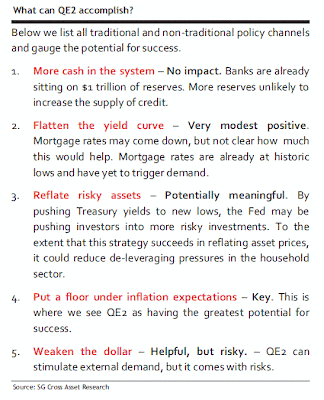
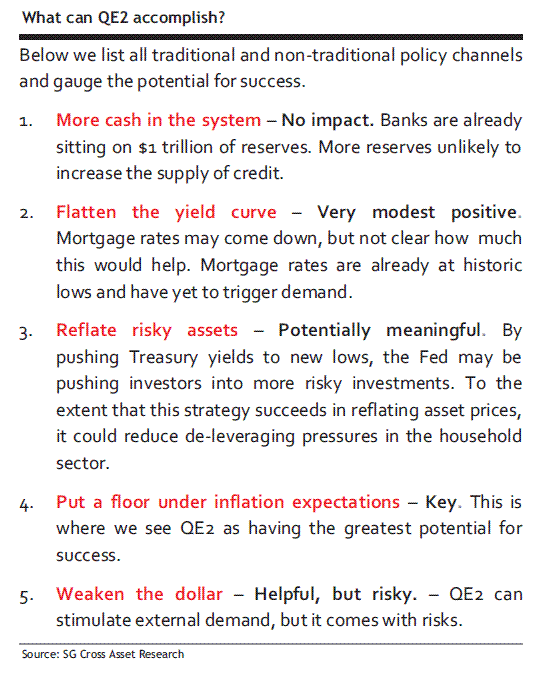
SocGen Gauges The Potential For QE2 Success
Fed is supposed to be designing your inflation expectations, that outweighs the risks ... in worst case those of currency debasement, which will be followed by the collapse of real activity and currency struggle typical for emerging markets.
Click on picture to enlarge, courtesy of Societe Generale.
Click on picture to enlarge, courtesy of Societe Generale.
J.P. Morgan: Central Banks Are Boosting Confidence
Is this another "In Ben we trust" story at J.P. Morgan? Current markets view suggest to add risk as short covering in equities is supposed to be good investment strategy:
• Economics: Activity data are tracking our forecast of growth close to potential.
• Asset allocation: QE boosts investor confidence. Add risk.
• Fixed income: QE on the horizon supports core bond markets, but look for Australia and Canada to decouple.
• Equities: Negative pre-announcements point to a worse EPS outcome in 3Q relative to 2Q, but seem largely priced in. Short covering has further to go.
• Credit: Medium-term strategy remains long credit, favoring EM over DM, corporate over state, and US over Europe.
• FX: Add to USD shorts.
• Commodities: Much stronger-than-expected demand for crude oil leads us to raise price forecasts, from $75 to $81 average for 4Q. Go long crude oil.
Monday, September 27, 2010
Broad Money Growth Stabilising ...
From the economists at BNP Paribas today:

Continued slide in the money multiplier?
Broad money growth is showing tentative signs of stabilising at very depressed levels…
Despite still-rapid growth in narrow liquidity, broad money growth remains extremely depressed, although there are tentative signs that the growth rate is flattening out.
Broad money growth across the G7 has stabilised at around 2% y/y, its lowest level for at least 25 years. The combination of fast narrow money growth and sluggish broad money growth means a continued slide in the money multiplier.
Canada and Japan are showing the fastest broad money growth rates at 5.9% and 5.0% y/y, respectively. The UK and eurozone, with broad money growth at close to zero, are the laggards. US broad money growth has picked up to almost 2% y/y, although it remains below the 6% y/y pace registered in late 2009.Click on chart to enlarge, courtesy of BNP Paribas.

Continued slide in the money multiplier?
Thursday, September 23, 2010
Trans-Atlantic Credit Miracles
EconompicData had a story of Microsoft borrowing on the CHEAP yesterday. However, on the other side of Atlantic, the credit affairs, according to Suki Mann, the credit strategist at Societe Generale, less bullish than the headlines from the other side of pond suggest:
European credit investors are getting a little bothered by the poor performance of new issues at the moment, and rightly so. The market actually might not be in great shape. Everybody thinks everybody else is a buyer - hence the oversubscription levels and no follow through. The problem is that the issues are priced rich but a fragmented European market place continues, as always, to get dragged in. There is an almost blasé attitude developing in some quarters that we will be ok in a few weeks when the deals will get absorbed better. Some will but we shouldn’t take it for granted that they'll all trade through reoffer. Short memories only go back to 2009 when that was the case - uniquely; in the history of the credit market there were many more years when this wasn’t so. All deals won’t/shouldn’t necessarily trade through reoffer levels. After the Fed communiqué on Tuesday, we’re now prepared for yields to stay low for longer. That does mean a continued demand for (higher yielding) credit and this will - unfortunately - support the issuer/syndicate axis for deals to continue to be priced rich versus secondaries. Broadly, there is increasing concern on the level of supply and how much we might get going forward.Also equities are less enthusiastic on the European side ...
Wednesday, September 22, 2010
Fed's POMO & S&P 500
It is not only Zero Hedge, but also BNP Paribas believes that Fed's POMO helps risk assets in general:
Click on chart to enlarge, courtesy of BNP Paribas.

Is it free market capitalism?
In the meantime, as we noted yesterday, what is helping in addition to growing expectation of further QE has been the POMO (Permanent Open Market Operation) actions by the Fed, where the Fed purchase USTs and put money out into the financial system, increasing the liquidity in the system and reducing the amount of USTs to help bring down yields and hence risk premia and this dynamic plays out throughout the risk spectrum. By not retiring cash from mortgages that are being refinanced and maturing, the Fed is preventing the money supply rate M1 from falling and also hurting a fragile economy.
Click on chart to enlarge, courtesy of BNP Paribas.

Is it free market capitalism?
Tuesday, September 21, 2010
Fed Decides To Stay On Sidelines
WSJ MarketBeat has posted the Fed Statement: What Market Watchers Are Expecting before the event, just to provide some pre-light.
While Fed uses seducing inflation language, Fed "... will continue to monitor the economic outlook and financial developments and is prepared to provide additional accommodation if needed ... ".
So, the economic optimists should not expect any additional accommodation, before it gets really worse? The bears should also be disappointed, as it is not that bad in the eyes of FOMC to provide additional accommodation now?
Either it is better than the leading indicators suggest, or markets have been eating hope recently? You decide ...
WSJ Real Time Economics is parsing the Fed ...
While Fed uses seducing inflation language, Fed "... will continue to monitor the economic outlook and financial developments and is prepared to provide additional accommodation if needed ... ".
So, the economic optimists should not expect any additional accommodation, before it gets really worse? The bears should also be disappointed, as it is not that bad in the eyes of FOMC to provide additional accommodation now?
Either it is better than the leading indicators suggest, or markets have been eating hope recently? You decide ...
WSJ Real Time Economics is parsing the Fed ...
Subscribe to:
Posts (Atom)