Tuesday, November 30, 2010

UBS Key Investment Themes For 2011

From global equity strategy team at UBS as of yesterday:
- Maturing Cycle: A more mature cycle comes with consequences. For the corporate sector this means peaking profit margins and slowing earnings growth. However, we look for PE multiple re-rating to more than offset slower growth expectations.
- Corporate re-leveraging: The corporate sector is ripe for a multi-year period of re-leveraging. With high cash balances and peaking profit margins, RoE (return on equity) will be pressured. An increase in leverage – first as a drop in cash (via hiring and capex, buybacks, dividends, and M&A) and ultimately via debt issuance – will support RoE.
- Financials - Differentiating good and great: The difference between just a good year for returns versus a great year will come down to the Financial sector, which continues to lag the broader market. Concerns about sovereign issues and capitalization need to fade, allowing investors to look to 2012 for sustainably higher profitability to boost valuations and drive material price upside.
- Political economy: Politically-driven policy decisions will continue to impact markets in the coming year. A rise in social tension within advanced economies, sovereign debt crisis in Europe, and a rise in trade protectionism related to rebalancing of global demand are all issues that are likely to remain on markets’ radar screens.
- Dividend yields: We believe the search for yield will be an enduring theme. In the near-term, yields will be more important in more structurally weak sectors or in one-off cases where there are substantial payouts to shareholders as a part of re-leveraging.
Still time to get prepared for?

Click on chart to enlarge, courtesy of UBS.

7 Key Calls For 2011 By SocGen

Global Asset Allocation team at Societe Generale makes following 7 Key Calls for Multi Asset Portfolio in 2011:
>> Key Call 1 – Buy EM Bonds without currency hedging vs USD or EUR in order to get exposure to EM FX. Growth profile, strong public balance sheet and the quest for yield should continue to support net inflows.

>> Key Call 2 – Long Nikkei / Short HSCEI (Hang Seng China Enterprise Index): Asian inflation would be welcome in Japan, but would trigger policy tightening in China.
>> Key Call 3 – Long Corporate Bonds BBB / Short Corporate Bonds AAA: The lower-rated categories are set to outperform the higher-rated ones as the spread compression process slowly continues in H1 and investors keep looking for yield instruments.
>> Key Call 4 –Steepening of 30Y-5Y US yield curve as the Fed's QE2 programs will concentrate on 5Y maturities and are likely to feed long-term inflation threats.
>> Key Call 5 – Long Global Telecom Services / Short either Global Capital Goods or Global Utilities: prefer the high dividend yielder (Telecoms) over either the low dividend yielder (Capital Goods) or expensive and riskier assets (Utilities).
>> Key Call 6 –Buy 10Y Australian government bonds (in AUD): strengthening currency, AAA-rated offering a 5.5% yield in an environment where the market is starving for yield.
>> Key Call 7 – Keep long exposure to Gold: in order to hedge against the debasement of G4 currencies and rising long-term inflation threats.
While this is quarterly update, 8 months ago the calls were like these ...

Monday, November 29, 2010

US To Decouple from Europe?

US equities recover again from early sell-off in the morning due to concerns about European debt crisis, and multi-national corporate sector with healthy balance sheets appear to be like safe haven ...

But Jim Reid, the strategist at Deutsche Bank commented today:
For 2010 we're not surprised we've seen the need to rescue Greece and now Ireland. We're certainly not at all surprised to see concerns over Spain now rising again. What we're probably surprised at is given the extent of the Sovereign problems how well risk assets have performed. Had someone told us in December 2009 that Greece, Ireland, Portugal and Spain CDS would be trading +706bp, +444bp, +411bp and +210bp wider in 2010 at 988bp, 604bp, 502bp, and 323bp respectively as we near the last month of the year then we would have been very impressed that the S&P 500 and Stoxx 600 were +6.6% and +5.0% respectively YTD. For this, authorities deserve credit for containing what we still think have been and are still colossal problems. Can they succeed again next year?

Another View For Economies & Financial Markets In 2011 & Beyond

As advertised on Barron's, but more in details here, Citi came with their own view for 2011 and beyond, with brief summary outlined below:
2011 is likely to be another year of strong but uneven global growth. We forecast global GDP growth of about 3.4% in 2011 and 3.8% in 2012 — somewhat below the 2010 pace (3.9%) — but still above the 1999-08 average of 2.9% YoY. The expansion will remain very uneven, more so than in prior recoveries. EM Asia should again outperform as the multi-decade transformational booms in China and India continue, not just in 2011 but for many years after. Industrial countries overall should record only modest growth in 2011 because of private sector deleveraging and, in many cases, fiscal consolidation. Divergences are likely to remain acute in the euro area, with continued above-trend growth in Germany but — even after severe recessions — little or no growth in the periphery countries. Global imbalances should stay high.

The Fed, ECB and BoJ are all likely to keep policy rates on hold in 2011. We have delayed our forecast for the first ECB hike into 2012. The Fed probably will keep rates on hold until well into 2012, with the BoJ on hold until at least late 2013. Only a few industrial countries are likely to hike rates in 2011: those with high growth (e.g. Australia, Sweden, Switzerland) and — amidst sticky inflation — perhaps the UK. By contrast, with strong growth and rising inflation pressures, tightening should be widespread across EM in Asia and LatAm. We expect China to hike by a further 125bp by end-2011 and more thereafter.

Chief Economist Essay by Willem Buiter ... There is no absolutely safe sovereign — ‘rates analysis’ has to be done together with ‘credit analysis’. Ireland’s bailout package will buy some time, but does not address its fundamental solvency issues. The Irish case also highlights the need for an EA/EU wide bank resolution regime. Portugal is likely to access the EFSF soon, in our view.

Citi’s market strategists have generally looked for reasonable returns from risk assets over the last year and remain reasonably constructive for the coming year — albeit emphasizing the need to be selective amidst uneven global growth.

Thursday, November 25, 2010

Bailouts "Über Alles" Today

Axel Weber was vocal already yesterday. The economists at Commerzbank, in addition to comment at Bloomberg, wrote:
Germany’s most important central banker, the head of the Bundesbank Axel Weber, therefore made it clear yesterday that if necessary the EFSF funds would be increased and speculation against the euro was therefore pointless. To the surprise of many in the audience he pointed out in a speech in Paris that we were no dealing with a crisis of the euro and the Eurozone but the problems of individual countries. So what are we to make of his comments? (1) Weber’s monetaristic view that we were dealing with a crisis of individual countries rather than of the Eurozone is correct. But from the instance when the Eurogroup decided to help Greece and then extended the rescue package to all other countries it became a crisis of the Eurozone. (2) The reference that if necessary the EFSF funds would simply be increased is intended to illustrate to the markets: we will stick to our plans and we know what to do. The announcement is however quite dangerous. After all it is far from certain whether the funds can be increased as easily as that. The German chancellor for example would have to face the Bundestag once again asking for further funds. There is likely to be increased resistance in other donor countries too. So there is a danger that markets are going to consider also this statement to be premature thus increasing market scepticism regarding the ability to act among those responsible. (3) So that leaves Weber’s assurances that an attack on the euro was pointless. The fact alone that there are transactions worth USD 1000bn. in EUR-USD every day illustrates that there cannot be any speculation. What we are experiencing at present is not a speculative attack but a (justified) depreciation due to unsolved problems. Moreover levels above 1.30 in EUR-USD demonstrate that the euro is still not a weak currency.
But today's headlines from DowJonesNewswires provided another boost for equities again, should read bottom-up for historical appearance:
*DJ ECB Weber: Fiscal Policy, Not Euro Itself, Is Source Of Current Problems

*DJ ECB Weber: Crisis Has Damaged Euro-Zone's Function As Stabilizer
*DJ ECB Weber: Future Mechanism Won't Impact Existing Contracts
*DJ ECB Weber: Swift Decisions On Mechanism Would Calm Markets
*DJ ECB Weber: Need Well-Prepared Crisis Mechanism
*DJ ECB Weber: Need Broad Early Warning System Going Forward
*DJ ECB Weber: Euro-Zone Sanction Proposals Not Automatic Enough
DJ ECB Weber: Euro-Zone Members Have No Choice But To Protect Euro
*DJ ECB Weber: EUR140B More In Aid Would Be Supplied If Necessary
*DJ ECB Weber: Spain Highly Unlikely To Need Euro-Zone Aid
*DJ ECB Weber: Scenarios Where Existing Bailout Too Small Almost Impossible
*DJ ECB Weber: Existing Euro-Zone Bailout Only Too Small In Most Pessimistic Scenarios
*DJ ECB Weber: Euro Is Not In Danger
*DJ ECB Weber: No Functional Alternative To Euro
*DJ ECB Weber: Euro Among World's Most Stable Currencies
Click on intra-day chart of German DAX Equity Index to enlarge, courtesy of Bloomberg.to enlarge, courtesy of Bloomberg.


While the Spanish 10-year government bonds remained little impressed, click on intra-day chart, courtesy of Bloomberg.

Wednesday, November 24, 2010

Commodities Tradewinds?

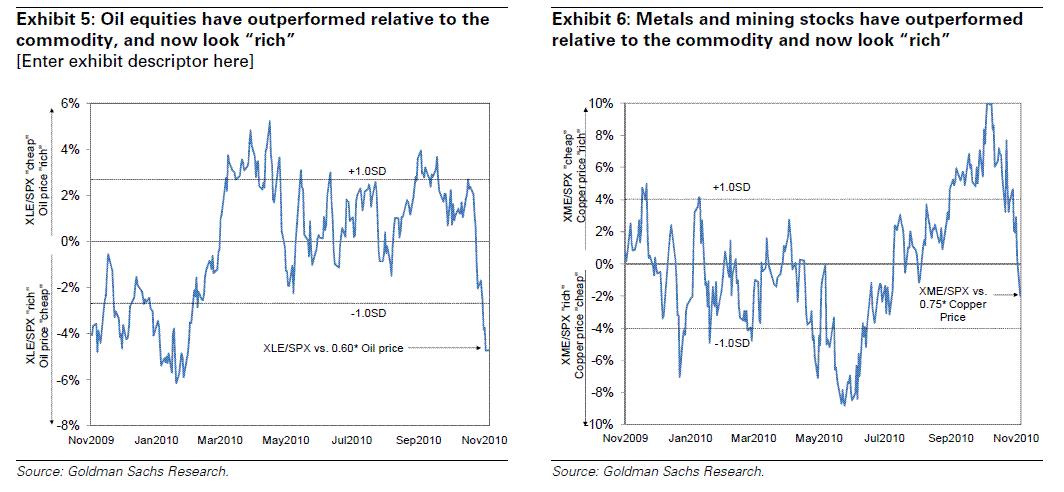
It is quite clear that equities in material and energy sectors have outperformed the commodities itself. Click on the charts below to enlarge, courtesy of Goldman Sachs.


But, the interesting thing around this situation is the opinion of analysts at Goldman Sachs:
Instead, it seems as if China worries have been heaped on the formerly “rich” asset class – commodities – not the “cheap” one – equities. Now, the state of affairs is quite the opposite, with equities rich on these measures and commodities cheap. And unlike during the 2008 episode, we think the usual convergence dynamics will likely hold sway, with the current gap once again closing.
Did you know that commodities were "rich"?

Tuesday, November 23, 2010

Pyongyang Draws Attention

Asian markets tumbled today, as Pyongyang draws attention again. Nomura had to say as follows:

Historically, Pyongyang has resorted to this kind of tactic to draw international attention and restart talks. It is likely that today’s attack was also motivated by the desire to initiate discussions again. Although we expect significant international pressure to keep the North/South situation calm, which should allow markets to return to some normality, with only relatively vague details available at this juncture (e.g uncertainty over the full number of casualties; the extent of multilateral sanctions) it is difficult to judge whether this will be a prolonged event for markets.
However, strong hands make bold decisions? Danske opines that status quo no longer an option.

The real drama, though, is and will be played in Europe, in my opinion. The Gods of Finance should save the Italy, but Spain is clearly on the path to challenge the credit ... as the cash benchmark yield spreads to Germany reveal today, see the chart below.

Monday, November 22, 2010

Bailing Out Irish Uncompetitiveness

Of course, exposure to Irish wealth bubble makes markets nervous, and the bailout news are crowding out the headlines also today. Just to sense how far the Irish are from German bottom look at the chart below.

Click on chart to enlarge, courtesy of Deutsche Bank.


Just wait when and if Spain comes to the forefront.

Friday, November 19, 2010

Tug Of War - Latest Global Outlook By BNP Paribas

While you can read all main features here, the risks are:
On growth, recent data suggest that downside risks have diminished considerably, led by China. The chances of a double dip in the US have reduced by about half from the previous 25%. The Fed’s QE also reduces downside risks.


Overall, growth risks are balanced. The upside risk is firms eventually putting cash balances to work in investment and hiring. The downside risk is no improvement in labour markets or consumer incomes and spending.

Vulnerability remains to financial shocks, though the less severe reaction to stress in the eurozone peripherals suggests a reduced sensitivity.

Data may be uneven due to slow final demand growth and inventory and trade swings. The market’s assessment of growth could be fickle.

Europe’s periphery remains a problem and opinions may swing due to data, political developments in the periphery and German comments driven by domestic politics. Adverse shocks are more likely than good ones, which would be EUR negative. Bad news about banks cannot be ruled out either.

We are confident about subdued core inflation in the eurozone, US and Japan. China’s inflation could continue to surprise on the upside but price controls should reduce risks on this front. The main upside risks we worry about are food and oil, in that order. Headline inflation remains subject to difficult-to-predict swings.

On policy, the Fed could surprise on QE – but in our view more likely by doing more rather than less than has already been announced. The skew of risks on ECB policy is probably towards more tightness. Wage developments as well as growth in Germany will be important to ECB policy. China could be more aggressive on tightening than we think if inflation is stronger, giving downside risks to risk assets.

Tensions remain severe between the US and China and more clashes seem likely on the currency, risking currency and trade wars.

We expect markets to be volatile, but central banks will try to curb the vol. They might even succeed, in which case risk assets would do better and the USD might be weaker.

The market’s reaction to QE2 remains uncertain over the longer term. On the one hand, the Fed is reducing Treasury supply to the market, which is bond positive, while promising to raise inflation – which is bond negative.

The bond forecasts look balanced near term, but upside risks from commodity risks give an upside skew later.

QE2 is a downside risk for the USD across the board.

BBVA Goes On China Banking Watch

Success in capital-raising contains risks, according to BBVA today.