Tuesday, June 30, 2009

SocGen: Public Finances - The Impossible Equation

The economists at Societe Generale have an "eye-opening" commentary on public finances today:
As public deficits are surging to unknown territories, the average debt ratio of the advanced G-20 countries is expected to jump by 20 points of GDP between 2007 and 2009 according to the latest IMF forecasts, and by nearly 40 points by 2014. This huge deterioration in public finances comes precisely at the moment when governments were supposed to make special efforts in order to face the fiscal consequences of an ageing population. Starting from now, the ageing population is expected to add 3% to 4% of GDP, or even 9% of GDP in the case of Spain, to public deficits in the next 30 to 40 years.
... One first goal could be to stabilise these debt ratios. This can be achieved easily if the difference between the rate of growth of the economy and the interest rate is positive, which was the case in the 70s when inflation was strong (see graphs below).
Click on chart to enlarge, courtesy of Societe Generale.


Said differently, the debt ratio stabilises if the economy manages to create enough revenues to compensate for the cost of the accumulated debt. But, without higher inflation, this is unlikely to be the case anytime soon as 1) interest rates have been abnormally low, and 2) GDP growth had been boosted by these abnormally low rates. The other solution would be to make painful efforts, i.e. the primary balance (which excludes interest payments) would have to be more and more positive. Otherwise, the debt ratio could very quickly reach the 100% threshold. Another goal could be to bring the debt ratio back to a level which allows room for manoeuvre in budgetary policy. The IMF has done some calculations to see what would imply a come back of debt ratios to 60% of GDP. Results are scary. They show that most of the countries, excluding Germany (1.8%) and Japan (14.3%!), would need to make an effort of 3% to 5% of GDP during the next 15 years to achieve this result. This looks simply out of reach, especially if every country pursues the same target at the same moment. Thus, back to the 70s?
As even maintaining near zero growth in US consumer spending requires immense fiscal stimulus these days, and any cyclical recovery depends on them, there is only one question:

WHAT HAPPENS IF MARKETS SUDDENLY REALISE THAT THERE ARE
"TOO MANY TO SAVE"?

Bylov: Weekly Inter-Markets Trading View

Jan Bylov, chief analyst at Nordea Markets, is a "rare specie" among analysts, as he is looking himself at all asset classes and uses inter-market approach in analyzing the markets. He writes in the summary today:

Stocks – The clash of opinions

From a general fear of systemic failure, global depression and unlimited downside risk opinion has slowly transformed towards hope (and stock prices with it) that the worst has already been seen. Recently, however, it appears that opinions have begun clashing whether prices and valuations have run ahead of the macro reality as most data improvements are due to base effects. With market action revealing mostly range trading – as opposed to outright deterioration – the vote for the next big stock market move is probably still out there, and we should rather view markets in a position where odds have moved back into balance. Lets keep our eyes wide open and less biased about what surely must happen next from current price levels. Consequently, a summer chill and a recovery peak still lack real confirmation e.g. via major stock market indices clearly breaking below the May reaction lows (S&P 500 @ 878, MSCI World @ 910 & DAX @ 4653).

Bonds – Exit plans several chess moves too early

So when should the so called “exit plans” begin influencing the price discovery beyond the short-term? With the last twelve months’ experiences in mind - and the rollercoaster psychological swings in particular – market operators are likely to remain unusual sensitive to the ever oscillating moves in market opinions. In this respect, we find it interesting that the recent exit-plan-scare began fading right when yields were approaching historic important levels of overhead trading (bond demand) and that officials began voicing not repeating the Japanese monetary policy mistake of the ’90ies. Now, this latest apparent change of market focus supports our general belief that central banks won’t commence removing the accommodation before clear and real macro improvements are evident i.e. when the economic business cycle has joined the post March financial business cycle recovery; execution of exit plans are several chess moves too early! Consequently, our long held guesstimate of overall range trading in long bond yields is slowly improving its odds with the transient investment themes probably swinging between: 1) “supply fear and exit plans” and 2) “global output gap and central bank responses to protect a fragile global macro economy”. The latter appears to be gaining momentum!

Commodities – Metals hold up well

Although oil and industrial metals already have approached price levels questioning additional recovery potential there remains no real market action confirming important recovery peaks. Rather, odds just appear to be moving back into balance… and we still need oil and copper to experience falls exceeding previous post March setbacks (15%-16%) to confirm a recovery peak in the economic growth sensitive commodity sector.

Currencies – Eyes wide open

It is a challenge to be unbiased and an everlasting goal of keeping our eyes wide open. Currently, it appears that opinions are clashing whether or not the global recovery in asset & debt markets have run ahead of the macro reality. We would argue that odds are “just” moving back into balance rather than having provided real market action confirmation that a new and more hostile period is ahead of us. So far, there is no safe heaven USD buying and our carry basket (long RUB, BRL, TRY vs. short CHF, CAD) is performing. Currently, the worst which might be said is that currency bets appear very concentrated on cyclical sensitive currencies when judged by the CoT report of speculative currency traders (primarily hedge funds) – not least in AUD.

Consider as a probability!

Rogoff: Latvia Should Devalue ...

According to Bloomberg:
Rogoff Says Latvia Should Devalue Its Currency, Direkt Reports

June 29 (Bloomberg) -- Latvia should devalue the lats to avoid a worsening of its economic crisis, said Kenneth Rogoff, a Harvard University professor and former chief economist at the International Monetary Fund, in an interview with Direkt.

The IMF made the wrong decision when it allowed Latvia to keep its currency peg, Rogoff said in Visby, Sweden today, according to the Swedish news agency. While a quick devaluation would be best for Latvia, Rogoff doesn’t believe it will happen for a long time because the IMF and Europe will provide the Baltic nation with loans, Direkt reported.

In a normal situation, Latvia would already have devalued the lats and defaulted on its debt, Rogoff said, according to the news agency. World leaders have decided no countries should be allowed to fail and Latvia is benefiting from that, he said.

If Latvia devalued, there is a risk that the turbulence would spread to other countries, which is why the IMF is supporting Latvia, Rogoff said.

Interestingly, what is going on behind the scenes at IMF, if former economists like Rogoff, Johnson, Roubini are leaning towards devaluation? The game rather appears to be about winning the time? For what? Just imagine like 1/3 of private borrowers going bankrupt ... how do you handle it?

Monday, June 29, 2009

Saut: We Remain Cautious, But Not Bearish

Jeff Saut, the respectful strategist at Raymond James has posted his weekly missive, see the latest version here. Last time on this blog Jeff suggested this.
His call for this week (but read the full story) in very short:
We have now experienced two consecutive down weeks in the SPX, the first such occurrence since the March “lows.” Worryingly, both weeks contained a 90% Downside Day, which is why we remain cautious, but not bearish. Indeed, according to Bespoke Investment Group, July has historically been a strong month for equities, with an average gain of 1.17%, and a 70% positive monthly track record over the last 20 years. However, late last week the Russell Rebalance (Russell Investment Group rebalanced its 25 U.S. indices) created some “noise” that is unlikely to abate until quarter’s end. And speaking of noise, this morning we find out that even Greenpeace is against the Cap and Trade Bill as things remain curiouser and curiouser . . .

Consider as a probability!

Friday, June 26, 2009

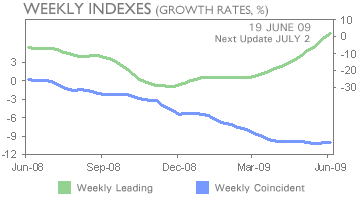
ECRI: WLI Growth Turns Positive

" ... end to the (US) recession is at hand":

June 26, 2009 (Reuters) - NEW YORK, A gauge of future U.S. economic growth rose, and its yearly growth rate turned positive, raising hopes that the end of the recession
is in sight, a research group said on Friday.

The Economic Cycle Research Institute, a New York-based independent forecasting group, said its Weekly Leading Index rose to a 37-week high of 117.6 for the week ending June 19, from a downwardly revised 117.0 the previous week.

The index's annualized growth rate spiked to a 97-week high of 2.1 percent from minus 0.6 percent a week ago.

It was ECRI's highest yearly growth reading since the week ended August 10, 2007,
when it stood at 3.4 percent.

"Following a 28-week upturn, WLI growth has broken into positive territory for the first time in over 22 months -- an affirmation that an end to the recession is at hand," said Lakshman Achuthan, managing director at ECRI.

The weekly index rose in the latest week because of stronger housing activity and investor confidence, Achuthan said.

And some charts, courtesy of ECRI.


Is the worst over?
Well, one may guess, by reading - how the people earn money and spend it? The commentary on Personal Income in US in May by Societe Generale at your disposal:
Personal Income was the surprise component- but the impressive jump was due to government payments stemming form the Economic Recovery Act of 2009. The surprise there was more the concentration of payments in one month. The social
payments were made in May and appear to be fully recorded in the month. Wage and salary income were down slightly while other sources of income posted modest gains.

You look at real spending chart below, courtesy of Societe Generale, and inquiring minds would ask where the money goes?
Savings. Why not spending?

Citigroup: Emerging Markets Barely In The Foothills Of A Potential Bubble

Citigroup Global Markets published "Global Equity Strategist" on Wednesday, 24 June. The first page summary is rather short:
  • Safe Haven Selling — The rise in risk appetite has been matched by large selling of traditional safe havens. Assets in US Money Market funds are down 6% from peak levels.
  • Welcome Back — After 10 months of outflows, Global Developed Market funds are seeing inflows again. Emerging Markets inflows have been even stronger this year, returning more than half of last year’s outflows.
  • Bubble Talk — Emerging Markets fund inflows have come back earlier and stronger than previous recoveries. Talk of a bubble is beginning to gain momentum. But performance, valuation and equitisation suggest an Emerging Market bubble is premature.
  • The Next Mania — Elements are potentially in place for a bubble in Emerging Markets. The most important is easy money. Real policy rates are negative. Money supply growth has rarely been stronger. We would buy Emerging Markets on dips and prefer CEEMEA and Em Asia.
However, the emerging markets equities are "barely in the foothills of a potential bubble":
Does performance signal a bubble in Emerging Market Equities? Emerging Markets are up 50% from their lows but this is just a fraction of the gains we have seen in a previous bubbles. In the 1980s Japanese equities rose nearly 10 times before the bubble burst in the early 1990s. Global Telecom, Media and Technology stock prices rose 7 times in their bubble. Chinese equities were up nearly 7 times from 2003-07, while Indian equities increased 9 times in their bubble.
Click on chart to enlarge, courtesy of Citigroup.

The rally in Emerging Markets has so far been in-line with previous bubbles at the same stage. However, it is still far too early to call the current move in Emerging Markets a bubble, either in duration or magnitude (Figure 12), in our view. For Emerging Markets to enter bubble territory we would have to see them double then double again.
So, just buy on dips?

I read sources, e.g., Societe Generale, Citigroup, today that June new lending will reach up to 1.2 trillion RMB (CNY, Chinese Yuans) in China. BNP Paribas mentions 1 trillion RMB in June, and concludes:
... total new lending in H1 2009 would amount to RMB 6.84 trn ...
Just to give some perspective, the USDCNY exchange rate is at circa 6.8335, meaning that 6.84 trillion RMB/CNY are 1 trillion USD. Chinese nominal GDP in current USD is ca. 5 trillion USD. So, they are blowing new credit only ca. 15-20% of nominal GDP in 6 months?

The 1 trillion USD lending growth on China would correspond to more than 2.5 (actually closer to 2.8 trillion) trillion USD lending growth in US. All the noise about irresponsible money printing in the US?

Thursday, June 25, 2009

Levy-Yeyati: Latvia's Three Exit Strategies ...

Eduardo Levy-Yeyati, Director and Head of Emerging Markets Strategy at Barclays Capital, had a rather good post "Is Latvia the new Argentina?" at voxeu.org.

Latvians, if sticking to internal deflation story, should focus very much on REER (real effective exchange rate), and the graph by Levy-Yayati shows that the things are actually getting worse ...

... and he proposes three exit strategies:

As the defence of the peg becomes increasingly untenable, the focus is shifting to a few alternative avenues to avert a disorderly currency collapse.

Float
Judging from past experience, even if backed by an augmented EU-IMF program, a devaluation would overshoot the ex ante real exchange rate misalignment (which, based on the recent evolution of the Latvia’s REER, would place the needed correction already at a sizable 50%) fuelled by the run to dollarise savings before the new, higher exchange rate materialises. Argentina is a case in point – after the discrete 40% devaluation of January 2002 succumbed within a month to reserve drainage and parallel market pressures, the exchange rate overshot from 1 to 4 before coming down to 3 by end-2002.
However, given the current depth of the crisis and the fact that the inevitable debt write-downs that would benefit Latvian debtors at the expense of Scandinavian banks could boost the post-crisis rebound, devaluation may ultimately deliver the faster road to economic recovery.
But, in the particular case of Latvia, a good old devaluation would reset the clock for euro adoption and, given it potential implications for other ERM II countries, may draw little EU support. While this option remains the exit of last resort, it is unlikely to be the route chosen in the first place.

Euroise
The Argentine analogy is, again, illuminating. Faced with concerns about its peg’s sustainability after Brazil abandoned its crawling peg in 1999, an Argentine mission to Washington to secure the endorsement of the US to de jure dollarisation – and the lender of last resort services of the Fed – was given a sympathetic but discouraging message – even if Argentina presented an attractive payoff for such a contingent liability (which it did not), a treaty would open the door for other financially dollarised countries to request similar treatment and would never pass Congress.
By contrast, Latvia’s early euro adoption would only test the EU commitment to euro convergence – a key driver of the Eastern European leveraging story. However, politics are more complicated. In Europe, there are many countries currently warming up to adopt the euro that could see Latvia’s case as a useful shortcut to avoid improbable but still possible currency stress down the road. Moreover, Latvia’s main regional exposure is vis-à-vis Scandinavian banks; the fact that euro adoption would grant Swedish banks a euro lender of last resort (the ECB) should certainly make euro countries uneasy.
Ultimately, while euroisation seems to be the solution favoured by the IMF, it would only make sense provided that the Euro zone approves, an unlikely event.

Realign
A strategy halfway between euroisation and floating – a contained devaluation that preserves Latvia’s ERM II status – falls short by most accounts, but it is nonetheless the most likely to broker a compromise between all relevant players (the Lats, the EU, the IMF, Sweden). The natural way to implement this would be a negotiated one-off 15%-30% realignment of the central parity preserving the ECB commitment to intervene at the bounds, and the time table for euro adoption, accompanied by the widening of the current +-1% band to the ERM standard +-15%. True, it’s hard to find successful contained devaluations under a currency run in recent economic history. But there are more things at stake in the Latvian peg – even a devalued one – than just a nominal anchor, which makes this strategy, if not a sure cure, at least a viable therapy.
Crucially, the plan requires a “Uruguay 2002”-type solution to the banking problem – limiting or suspending emergency assistance to foreign branches, thereby eliminating about 60% of the foreign exchange bank liabilities (a scenario that the Riksbank is regarding as increasingly likely). As for domestic banks, full deposit insurance plus explicit government support should counter the deposit run and keep dollarisation within the banks. Should the run continue, banks would be nationalised, reprogramming deposits to reduce the pressure on the Lat and restructuring non-deposit liabilities. The other critical aspect of this strategy is, or course, IMF-EU-EBRD money (as in EBRD’s recent involvement in large local bank Parex) to defend the new band ceiling (since the inadequately adjusted exchange rate will likely be under stress), thus providing assurance that Latvia will not be the next Argentina.
Such a scheme should receive support from all quarters. The EU minimises contagion (despite some predictable near-term ripples), the IMF avoids another embarrassing collapse and ensures that some of the foreign exchange pressure is transferred elsewhere, and Latvia stays the ERM course and shares the losses with Sweden – a fitting epilogue to a crisis that was in part rooted in reckless lending by foreign banks.
For all the obvious similarities with Argentina 2001, Latvia presents a more complex case that is poised to become the acid test of euro commitment.
While there are many who are drawing more and more parallels with Argentina, here are some arguments, among others, that I am copying (slightly adjusted for better reading) from a confidential source, against those parallels:
  • While Argentina's peg was clearly a boondoggle from the start (if you look at the fact that Argentina pegging to the dollar was silly since much of its trade was with countries outside the U.S. and since it had different business cycles than the U.S., which meant importing U.S. monetary policy was just plain dumb). In Latvia's case, the majority of its trade is with the Eurozone...
and here I add the ERM2 requirements on top of that argument, well, Latvia got it too tight ...
  • Argentina was fiscally profligate…Latvia, however, has not been. In many ways, it was a victim of EUphoria, receiving massive capital inflows as its EU entry buoyed positive sentiment toward the country and its neighbors. These massive inflows fueled bubbles, which have now spectacularly burst. What under other circumstances might have resulted in a mild bust has potentially turned into a regional financial crisis given the global context – that is, that we are in the midst of a severe global financial crisis.
  • Not being in the midst of a global crisis with slumping growth around the world, the argument that a devaluation would improve competitiveness was more clear-cut in Argentina.
  • Latvia had a clear exit strategy – joining the euro, something Argentina did not have.
Well, joining the euro is not a panacea... as one may conclude by looking at, e. g., Spain, Ireland ...

Friday, June 19, 2009

Long And Relieved: Citi Strikes Me Again ...

I read the summary of Equity Strategy by Citi' s Tobias Levkovich today (North America Investment Daily edition), and it resembles the Merrill's Global Fund Manager Survey, I noted yesterday, in some way...
However, I would like to point out two paragraphs of that summary (my emphasis):

Fund performance shows a bullish bias emerging. A study of Bloomberg data shows that the vast majority of funds have outperformed the S&P 500 in the past month through June 17), the past three months and year-to-date, arguing that 2008’s portfolio manager performance anxiety has diminished markedly. Actively-managed US equity funds have generated returns averaging about 7% through May, versus roughly 3% for the S&P 500 over the same time frame and the differential is at its widest since 1983, according to Morningstar data.

Sentiment surveys display rebounding enthusiasm but not ebullience. Most sentiment work illustrates that the fear that gripped the investment community three months ago has dissipated in almost dramatic fashion. However, it is also fair to say that the mood has not turned truly bullish either as economic worries still abound. Nonetheless, we believe that the market catalyst of depressed investor
sentiment lifting is missing for further gains.

A 45% swing in the relative stock/Treasuries trade demonstrates a 1933-like bounce. Assuming that stock and bond prices end the year at current levels, the relative performance swing would be nearly as sharp as the one experienced in 1933 following the 1932 swoon of stock prices. While we foresee more modest gains from current levels, the bulk of the move may already have occurred and investors need to lower their expectations.

Anecdotal evidence supports a more buoyant Wall Street. In several instances of late, the very same investors who perceived our bullishness several months ago as bordering on lunacy now consider our market outlook (S&P 500 at 1,000 by year-end) to be too conservative. To some degree, we have been surprised by the speed of this turn of events but the equity market’s powerful move since early March most likely explains this shift.

Sidelined cash may not chase returns but markets can gr1ind higher. While it is popular to argue that all of the cash on the sidelines may need to make its way into equities, we suspect that two equity market collapses in the past nine years may keep investors a bit more on the side of caution, especially as their equity exposure is not as severely underweight as was the case in the early 1980s. Nonetheless, further improvement on the economy should support additional equity market appreciation this year, especially for names in the Diversified Financials, Insurance, Capital Goods, Tech and Energy areas with some select opportunities in the Materials area.

" ... display rebounding enthusiasm but not ebullience ... In several instances of late, the very same investors who perceived our bullishness several months ago as bordering on lunacy now consider our market outlook (S&P 500 at 1,000 by year-end) to be too conservative. To some degree, we have been surprised by the speed of this turn of events but the equity market’s powerful move since early March most likely explains this shift."

So, You decide! "Maximum pain and frustration rule" now requires a move higher, and not only that ...

S&P500 Technicals by SocGen

I wrote on Wednesday, that I have not decided ... and I have not until today. The upward move has deteriorated considerably, but it may be a short-term consolidation, as there is no really bearish signal yet.
Market is about fairly priced, and the upcoming positive hard US economic data are priced in ... Probably, a bit too optimistic, but only two weeks till the end of quarter I cannot find myself selling equities... yet.
I am wondering, but the Techncians at SocGen are painting my script ... well, they are better than me!
Click to enlarge, courtesy of Societe Generale.


UPDATED: Citi: Because So Few People Remain Unemployed For The Full 26 Weeks

I was reading the commentary on U.S. weekly jobless data by Citigroup (Global Markets) economists last night. Quite interesting arguments, indeed (my emphasis):
Weekly jobless claims rose mildly for the week of June 13th, but the four-week average continued to decline gradually. Continuing claims for the week of the 6th fell by 148 thousand, which was the largest one-week decline since 2001. Some market participants have claimed that this drop was caused by people's benefits expiring. While we would agree that some workers are falling off the rolls, this effect is far too small to account for the latest drop in continuing claims because so few people remain unemployed for the full 26 weeks. Swings in beneficiary rolls are mainly driven by the balance between the influx of new claimants and the outflow of people who find jobs. This difference can be quite volatile so it is unwise to make too much of a single week change. If continuing claims continue to fall, we would take it as a sign that the labor market was improving.
So, you know now! Excellent explanation? Why continuing claims decreased?

UPDATE:
Well, obviously I have to bring more clarifications ... Citi' s argument in itself (my emphasis in bold) is a non-sense without hard data ....

David Rosenberg, the chief economist and strategist at Gluskin Sheff, brought "the big picture" to the stage much better today:
All of a sudden, we have an army of economists now looking at the continuing claims data as confirmation that the green shoots are turning green again and that the pace of firing is subsiding. That may well be the case, but it is also the case that seasonal adjustment around the Memorial Holiday was at play, or the prospect that the massive 2.6 million people getting extended or emergency benefits may be rolling off. Either way, let’s not lose the big picture, here; claims have now been north of 600k for 20 weeks in a row, which is without precedent.