Sunday, February 08, 2009

Inflation vs Deflation: Steve Keen @ naked capitalism

This is "the must read" unconventional opinion, if anyone is going to claim understanding what is going on ...

UPDATE 9 February 2009 @14:50 (12:50 GMT):

I am leaving the economic idealogy for the economists themselves, but this bit by Steve Keen fits quite well with the Liquidity Economics lecture "Evil is the root of all money" by Nobuhiro Kiyotaki, London School of Economics, and John Moore, Edinburgh University and London School of Economics, we touched a week ago:

"Thus causation in money creation runs in the opposite direction to that of the money multiplier model: the credit money dog wags the fiat money tail. Both the actual level of money in the system, and the component of it that is created by the government, are controlled by the commercial system itself, and not by the Federal Reserve. Central Banks around the world learnt this lesson the hard way in the 1970s and 1980s when they attempted to control the money supply, following neoclassical economist Milton Friedman’s theory of “monetarism” that blamed inflation on increases in the money supply....

Saturday, February 07, 2009

Latvia: Is A Potential Disaster In Italy/Spain A Solution?

This is in no way a "consensus wisdom" at the moment, but problems at Italy' s bank UniCredit or the household debt default problem in Spain at some day may require a Europe-wide solution.

Edward Hugh has an interesting post "Italy Needs EU Bonds And It Needs Them Now!". Read the full article, but key conclusion for lazy reader here:

So how should we address this danger, imminent or otherwise? At this point in time I have four proposals:
a) The creation of EU bonds
b) The introduction of quantitative easing by the ECB (quantitative easing is the monetary policy which is currently being applied in both the US and Japan, and probably soon in the UK too).
c) Letting those members of the East who want to join the eurozone immediately do so.
d) A new "pact" - one which would be much, much stronger than the old Stability and Growth Pact - to be signed by all countries who enter the EU bond system, a pact which gives direct fiscal remedies to Brussels in the event of non-compliance together with a substantial dose of effective control over the economies of individual countries - since nothing, Mr Sr. Tremonti, ever comes completely for free.

Obviously all of this is quite radical, and indeed fraught with danger, but these are hardly normal times. In all of this (d) is obviously the most important part, as any protection given to EU member economies by the Union must be credible and serious. So no country could or should be forced in, but it should also be pointed out to those who chose sovereignty and remaining on the fringes to participation that they would run an enormous risk. Since almost all EU economies seem vulnerable at this point, anyone staying outside could rapidly see themselves exposed to the risk of forced default, since lack of protection is simply an invitation to attack. Letting ourselves get picked off one by one is not an appetising prospect (Latvia, Hungary, Greece, Austria, Italy, Spain, Ireland, the UK, Romania, Bulgaria.........).

Clearly those who wish to remain "dissenters" should have the liberty to do so, but they should bear well in mind that should they do so they could very easily end up in a group - possibly lead by Diego Armando Maradona - together with Yulia Timoshenko (Ukraine), Cristina Fernadez (Argentina), Rafael Correa (Ecuador) and (possibly) whoever is the new prime minister in Iceland, bankrupt, and without the aid of international financial support to help deal with their mess.

Perhaps readers may think I am being rather shrill here, and perhaps at this point Tremonti (for whom I have no afinity, elective or otherwise, see linked post above) is only playing brinksmanship, but if he isn't, and Unicredit is about to need bailing out, then push does quickly come to shove, since the EU leaders agreed on October 12 in Paris to bail out systemic banks, and Unicredit is a systemic bank. So will will need to know how they plan to stand by their commitment, and if they don't, well then everyone of us stands exposed, since credibility rapidly falls towards zero.

Maybe this is a false alarm situation, and Unicredit will not need bailing out this weekend, or the next one, but one day it will, and one day Spain's huge non performing loan and household debt default problem is going to need sorting out. So I think this is a line in the sand situation, and we are much nearer to having to make up our minds which side of the line we are on than many seem think.

To paraphrase Paul Krugman again, in flirting with the idea of whether the first to default should be Greece, or Hungary, we truly are flirting with disaster.

China Update

Here are some links for up-to-date facts and opinions:

Friday, February 06, 2009

ECRI: Weekly Leading Index Slips Again ...

No comment, take it dry ... my emphasis!

Reuters, February 06, 2009
A measure of U.S. future economic growth and its annualized rate fell in the previous week, indicating the economy will not recover in the near future, a research group said on Friday.
The Economic Cycle Research Institute, a New York-based independent forecasting group, said its Weekly Leading Index slipped to 106.1 for the week ending Jan. 30, from 107.3 in the previous week.
The index's annualized growth rate also declined, to negative 24.7 percent from negative 24.0 percent.
"With the WLI falling for the fourth straight week, almost to its cycle low, an economic recovery is not in sight," said Melinda Hubman, research associate at ECRI.
The weekly index fell due to higher jobless claims and weaker housing, with the slide partly offset by higher stock prices, Hubman said.
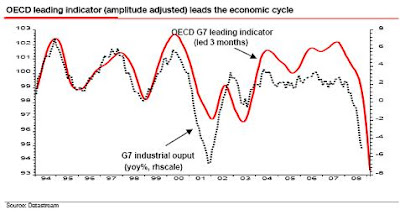
Hehhh, and OECD leading indicators also "fall to lowest levels since 1970s".
Reason for party!?

UPDATED: US NFP Watch, Consensus Analyst Estimate At 525k Loss ...


See for UPDATES below ...

U.S. publishes "the market mover #1" at 13:30 GMT - Non-Farm Payrolls (NFP). Analyst estimates range from 400k -750k loss according to Reuters. Similar data provided by Bloomberg, Dow Jones ... Consensus economist estimate is at ca. 525k loss, depending on source for that.

It is assumed that employment is a lagging indicator. Assuming current global consumption mess, I doubt that a sustainable recovery of economy is possible (excluding the fiscal stimulus) before employment stabilizes...

Assuming the "ADP wild guess" on Wednesday, that came in actually better than estimated by analysts, and weekly jobless claims that were actually worse than estimated by analysts, and the market reaction ... Errr, the market may be ready to shrug off 550k loss in January and neglect negative revisions for previous months, especially if sweeteners are offered, but I was wrong last month ...

UPDATE @ 15:45 (13:45 GMT): BLS reports 598k loss in January 2009, December revised 53k worse, November revised again 13k worse ...all in all, January report (including revisions for previous 2 months) is 664k loss, much worse than estimated by analysts ... but markets rather calm so far. German DAX index is even trying the upside.

UPDATE 2 @ 15:58 (13:58 GMT): Bespoke has a good post here.

UPDATE 3 @ 22:10 (20:10 GMT): here is the list of links with commentary on job report:
WSJ Real Time Economics compilation of opinions
Calculated Risk with Employment Diffusion Index
HSBC via Across the Curve
Paul Krugman' s politicos

Equities spike to upside (S&P500 up 2.10% now, but we were almost 3% up just 30 minutes ago ...) led by banks, KBW Banks up 11%, see more here ... well, appears to be very little to do with " fundamentals".

UPDATE 4 @ 23:20 (21:20 GMT): S&P500 finishes 2.7% higher, the financials lead the pack (sharpest rally occurs in bear market) with KBW Banks up almost 12%, S&P500 Financial sector up 8.13% ... this is against the jobless data, as how they will pay off their debts? The real explanation is in the previous post, but Obama' s Kiss has been downgraded some time ago? Yeaap, and the US 10 year Treasury yield rose just 8 bps ... Irresponsible policies?

UPDATE 5 @ 7-Feb-2009 14:25 (12:25 GMT): Dean Baker writes that jobs report is "worse than it looks"...

UPDATED Equities: Option Market Alert

UPDATE 3 @ 22:00 (20:00 GMT): nice "short covering" in financials, see up-to date chart for KBW Banks Index here, and the reason should be Geithner's Bank Rescue plan, expected on Monday? Well, we had the good/bad bank discussion ...

UPDATE 2 @15:50 (13:50 GMT): it looks like some people are very well informed what US Treasury and SEC are doing. A story that "mark-to-market" rules for valuing banks' assets might be abandoned was the basis for equity rally? See this story at FT Alphaville.

UPDATE @ 14:30 (12:30 GMT): Daily Options Report has a
story about bullish "gorilla" play in financial sector, and this is supported by "bullish speech" of Todd Harrison of Minyanville.com on Yahoo's Tech Ticker ...

Well, let's put the disturbing fact that equity market reversed to the upside yesterday exactly as the Fed announced the purchase of (officially the agency) bonds ...

However, let's look at rather extreme bullishness in the equity options markets. This, in contrary, would suggest the high risk of bearish action in the equity market. Option markets may be assumed as "smart", as they are putting just a fraction of share price to benefit from the upside, but the downside is limited to the option price (a fraction of full share price). The question is whether the real cash market will follow. ISEE index reached the highest reading this year, and is close to bullish extremes observed in the past 2 years, see the chart below. Same applies to CBOE Options Total Put/Call Ratio (just in reverse order whereby bullishness is seen at the bottom of chart). Usually it takes up to 3 trading days, for the market to change the direction. In "frugal plain" - the option market is extremely bullish, and if not followed by real cash market, may be hit hard...

Well, will the real cash market follow the "smart" option market?

Click on images to enlarge...


Thursday, February 05, 2009

Nasing Spesal: DnB NORD Said Its Operations In The Baltics Remained Profitable ...

These should be interesting folks... Alienated? Come!

Reuters reports today:

OSLO, Feb 5 (Reuters) - Bank group DnB NORD, owned by DnB NOR and Germany's Norddeutsche Landesbank, said its operations in the Baltics remained profitable but that bad real estate loans in Denmark would affect 2008 results.

The three Baltic states have been hit hard by the global economic crisis, and concerns have mounted over the bank's operations in the region.

"We have profitable banks in the Baltics in spite of the difficult situation there," Chief Executive Thomas Burkle -- who stepped into his new role this week -- said in an interview.

"Our operations (there) are actually doing quite O.K."

Look, there are people doing quite OK! Why these doom-sayers?

Edwards: Long-Awaited Equity Bottom?

The respectful Albert Edwards, the global strategist at Societe Generale, has been an ueber-bear for years. The key message today:

All of a sudden, investors seem to be spotting bright green shoots. A bounce in January’s economic data, both West and East (China mainly), has got commentators salivating in anticipation that the bottom of the economic cycle might be close. Hey, even UK house prices managed to bounce almost 2% mom – the first decent monthly rise in over a year. Maybe, against all the odds, Lazarus is about to take up his bed and walk?

One lesson from Japan’s lost decade is that, despite remorseless deflationary headwinds, the occasional aggressive policy response did produce some quite decent cyclical recoveries. Hence some very healthy cyclical equity market rallies can be enjoyed within the long Ice Age structural bear market.

That is exactly what the western equity markets enjoyed from 2003-2008. At the time, they felt like the real thing and investors fell in love with the rally. Instead they need to become far more promiscuous in their willingness to chop and change their equity preferences as the cycle ebbs and flows. Lack of attachment is a vital quality in The Ice Age.

We believe the US equity market is, even now, only “fair” value on our longer term cyclically adjusted PE measures - by contrast Europe could be considered cheap. We expect the lack of market cheapness in the US will result in a further 40% slide in equity prices as depression-like economic and profits data continue through 2009.

Our clear view is that we would expect depression-like data to continue to overwhelm investors for the foreseeable future. If the global economic cycle is hitting bottom I will eat my and any other hat clients produce. Nevertheless we are watching the leading indicators closely (see chart below), for even a moderation of the rate of economic deterioration may spark a bear market rally as investors mistake it for the prelude to actual recovery. Similarly, after the initial October 1929 crash, hopes of economic stabilisation sparked a 50% rally in early 1930. When this proved a false dawn equities fell a further 80% before hitting bottom!


FT Alphaville has more to say here ...

Soros: Asymmetry In Risk/Reward Of Directional Bet In Stock Market

Financial Times had an article "The game changer" by legendary George Soros, where he wrote:

...there is an asymmetry in the risk/reward ratio between being long or short in the stock market. (Being long means owning a stock, being short means selling a stock one does not own.) Being long has unlimited potential on the upside but limited exposure on the downside. Being short is the reverse. The asymmetry manifests itself in the following way: losing on a long position reduces one’s risk exposure while losing on a short position increases it. As a result, one can be more patient being long and wrong than being short and wrong. The asymmetry serves to discourage the short-selling of stocks.

Major Bullish & Bearish Candlestick Patterns

Technical analysis? Options Trading Beginner provides excellent summary of major bullish and bearish candlestick patterns. Here are some pictures (courtesy of Options Trading Beginner) to spot reversal of fortunes ...


Technical analysis is only a part of comprehensive framework ...